Eric Hoops took over as superintendent of Waconda↗ET Unified School District 272 on July 1, and one of the reasons he gives for coming is a compliment to the people already there.
"Waconda has been recognized recently for several high academic achievements," Hoops said in a written response to The KSEdTribune. "The staff and community of the district was very welcoming when we interviewed with the district and they have continued to be this way as we have settled into the area."
Whatever recognition he has in mind, the state's own testing record gives the district a case. Across every year of Kansas assessment results available, in every subject tested, a larger share of Waconda students reached Level 3 or Level 4 than in Kansas as a whole: nine years of English language arts results going back to 2015, nine years of math, and five years of science beginning in 2019. That is 23 subject-years without an exception. Kansas describes the top two of its four performance levels as the point at which students have reached grade-level expectations, and the state assessment program's guide for families puts it plainly: "Students in Level 3 and 4 have reached those expectations."
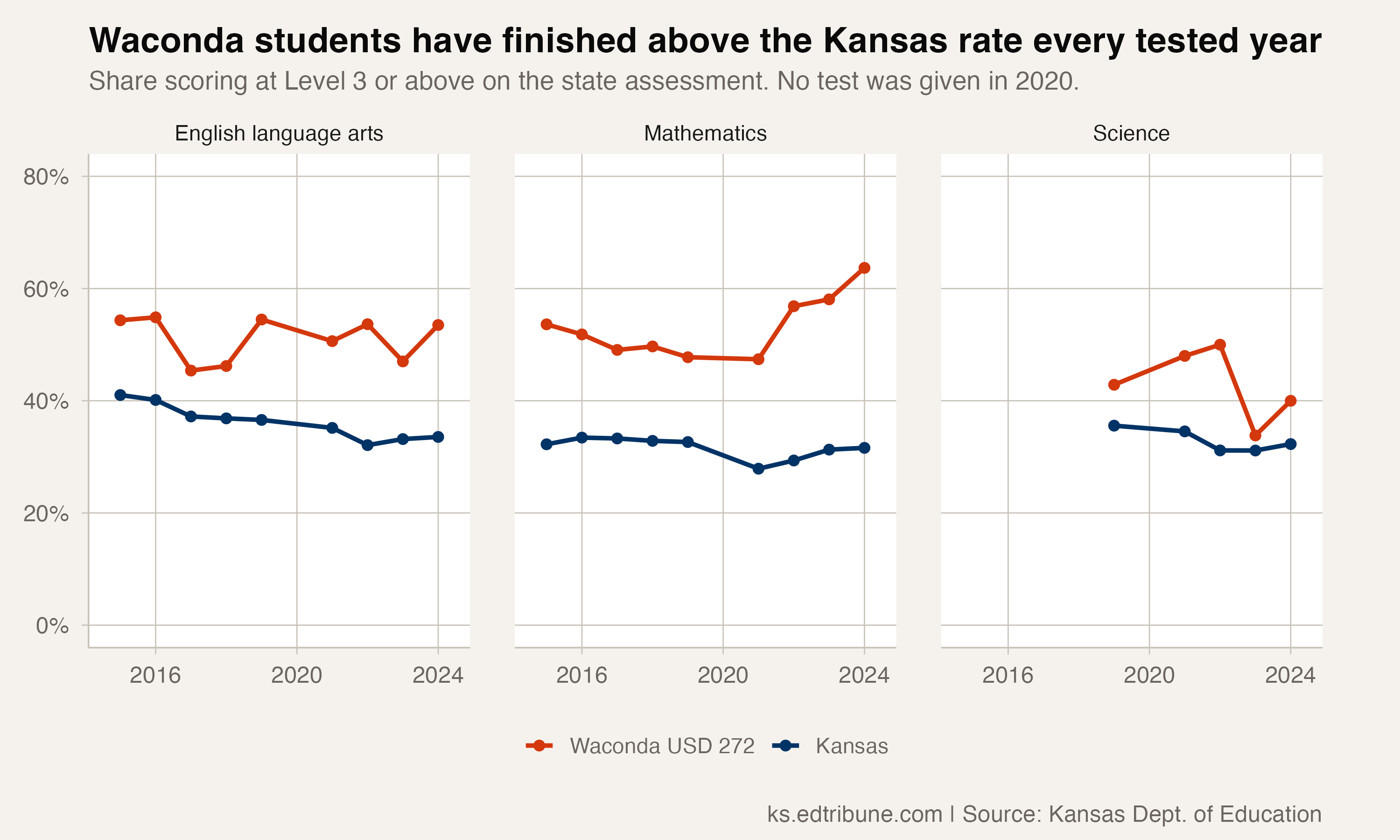
Math is where the distance is widest. In 2023-24, the most recent year published, 63.7 percent of Waconda's math results landed at Level 3 or above against 31.6 percent statewide, a gap of 32.1 points and the largest margin anywhere in the record. That figure is also 16.3 points higher than Waconda's own 2021 result. Kansas gained ground over the same span, by 3.7 points, so the district was not simply riding a statewide recovery.
Hoops succeeds Jesse Janssen, who announced in April that he would leave the superintendency at the end of the school year. Hoops confirmed the July 1 handoff in writing this month.
The district he now runs reaches into Mitchell, Osborne and Smith counties and includes Glen Elder, Cawker City, Downs and Tipton. Lakeside Elementary sits in Cawker City in Mitchell County. Lakeside Junior/Senior High School is in Downs in Osborne County, and Tipton Community School is in Tipton. Hoops treats the multi-community arrangement as an advantage rather than a logistics problem.
"The multi-community footprint of the district is also a positive, as each community takes great pride in the students and staff of their community and offers the support needed to make them successful," he said.
What he brings from the elementary side
Hoops comes to a superintendency from buildings rather than from a central office, and from the youngest grades in particular. He was elementary principal at Thayer Central Community Schools in Hebron, Nebraska, from the 2022-23 school year through June 2026. Thayer Central's board approved his appointment in January 2022, and the district listed him as elementary principal that November. Before Nebraska he was principal of Chanute Elementary School in Chanute, Kansas.
Hoops confirmed that he graduated from Deshler Public Schools, placing his own school years in another small Nebraska town. That lines up with how he explains the move to Waconda. He and his wife, Wendy, both grew up in small towns, he wrote, and their children, Kyzer and Korbyn, are now in a small district themselves.
Asked what carries over from elementary school leadership, he did not describe a program.
"Relationships are the key to education no matter your role or position in education," Hoops said. "Establishing strong, positive relationships with students, staff and community members will be integral to the continued success of our district."
The staffing sheet gives that priority something to work with. In 2024-25, the most recent year the state has published for the district, Kansas recorded two school counselors, a school social worker and a reading specialist among Waconda's licensed staff, alongside two principals and the superintendent's own position.
Where the elementary strength shows, and where it stops
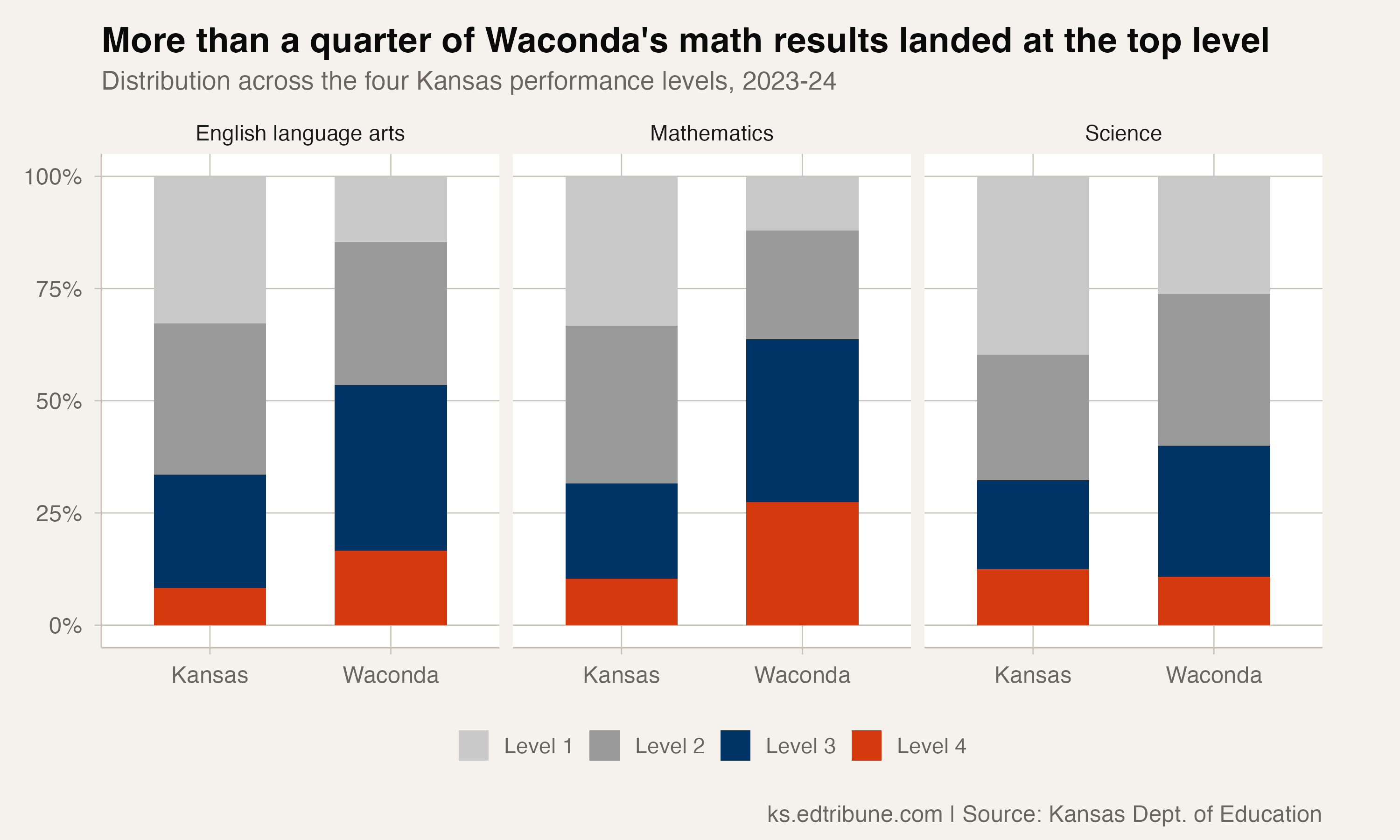
The 2023-24 grade-by-grade results explain a lot about how the district earns its district-wide numbers. In third grade math, 94.4 percent of Waconda's results reached Level 3 or above against 50.2 percent statewide. In fourth grade math the figures were 86.2 percent and 37.1 percent. More than a quarter of the district's math results overall, 27.4 percent, landed at Level 4, the top level, against 10.3 percent statewide, while 12.1 percent landed at Level 1 against 33.2 percent across Kansas.
One result runs the other way. Of the 17 grade-and-subject results the district reported that year, exactly one finished below the Kansas rate: 10th grade math, at 5.9 percent against 21.3 percent statewide. That figure is not an isolated one. Across the nine tested years, Waconda's 10th grade math results came in below the state in seven of them.
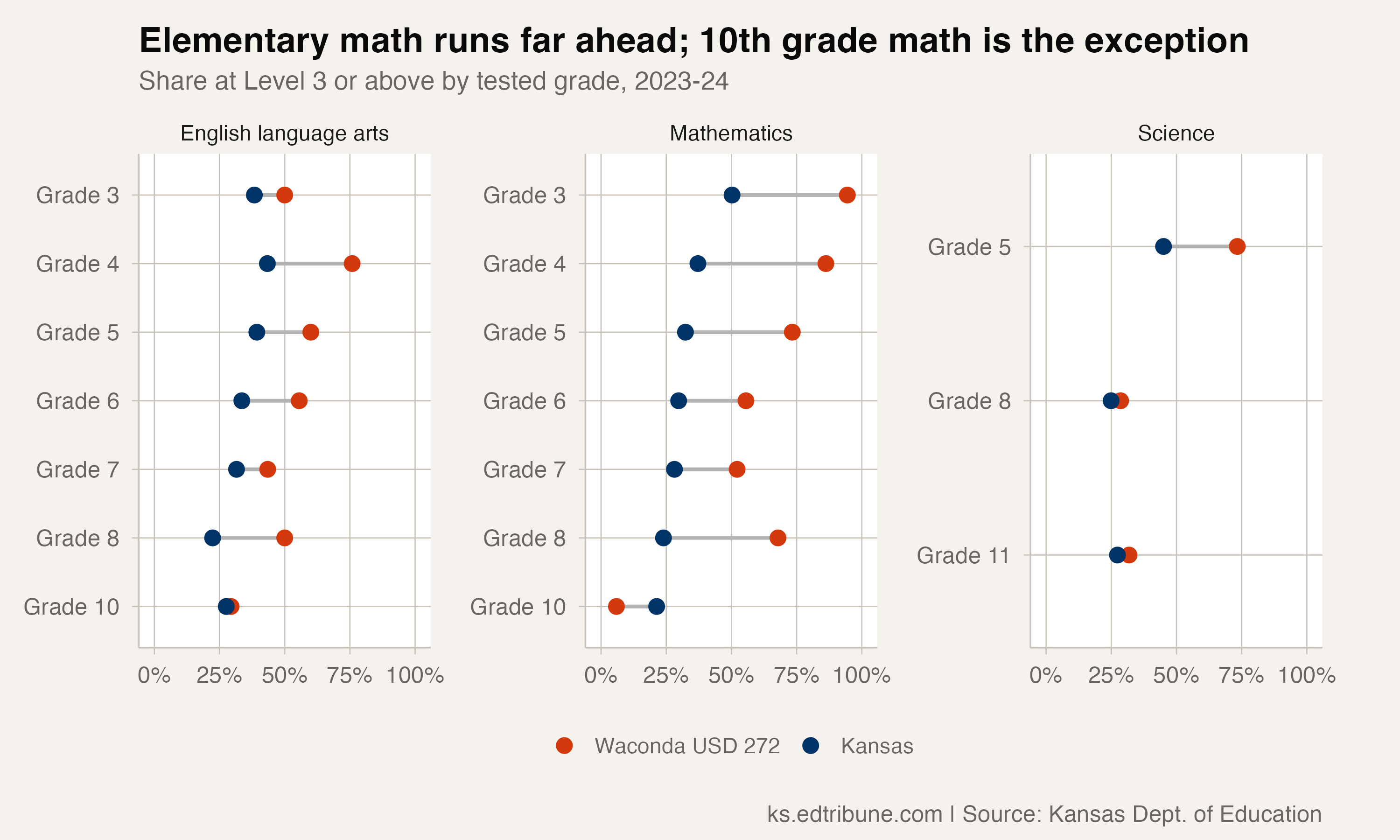
The number deserves a caution before it becomes a verdict. Kansas publishes assessment percentages without the count of students behind them, and in a district where a single grade is a single small group, that grade's result swings hard. Waconda's 10th grade math figure has ranged from 5.9 percent to 25.0 percent over the nine years and has moved as much as 17.9 points from one year to the next. What the series does support is that the pattern is old and predates Hoops. What it cannot settle on its own is whether the cause sits in the high school, in the course sequence that leads to the 10th grade test, or in the ordinary noise of small numbers.
Hoops points to the district's scale when he explains what the testing record shows.
"The small size of the district is a positive," he said. "This allows for smaller class size and more individualized instruction for students."
Nothing in the Kansas data isolates class size as the reason, and the state's files do not carry enough detail on a district this small to test the alternatives. That leaves his explanation as a practitioner's account rather than a finding.
His stated plan for the first year is to add nothing and subtract nothing until he knows the place.
"My early priorities are to establish relationships with the students, staff and community," Hoops said. "In addition, I look forward to supporting the great things that are already occurring here at Waconda. Waconda has a great staff with many great things already in place."
The record he is protecting is about to become harder to read. The 2023-24 results are the newest the state has published, and they are also the last that can be measured against this decade of history: Kansas moved to a new assessment scale and new cut scores in 2025, so the scores arriving during Hoops's first years will not be comparable to the ones that helped bring him here. He will be judging Waconda against a yardstick he has not seen yet, in the one subject and grade where its record has been thinnest, using the relationships he says he is starting with.
Assessment results and licensed staffing come from the Kansas State Department of Education. Quotes, the district-footprint correction and the June 2026 Thayer Central end date are from Eric Hoops's written responses to The KSEdTribune in July 2026. Other career details are attributed to the Hebron Journal-Register and to Thayer Central Community Schools as linked.
Detailed code that reproduces the analysis and figures in this article is available exclusively to EdTribune subscribers.
Discussion
Sign in to join the discussion.
Loading comments...