
Will Pfannenstiel did not arrive at the Arkansas City↗ET superintendency as an outsider learning a new district. He arrived after more than 20 years inside it.
"This wasn't really about taking a new job," Pfannenstiel wrote in response to questions from The KSEdTribune. "It was an opportunity to continue serving a district and community I care a lot about, just in a different role."
Pfannenstiel moved from an interim assignment to the permanent superintendency this summer. He said the temporary stretch in the chair gave him a sharper view of how closely connected district decisions are across students, staff, families, finances and the wider community.
His first-year agenda combines listening and relationship-building with visible work already underway: bond projects, facility improvements and development of the district's next strategic plan.
"I don't think one person should decide what the future of the district looks like," he wrote. "We need to listen to the people we serve and build that direction together."
That planning begins against an enrollment record that moved in both directions but remains below its earlier level.
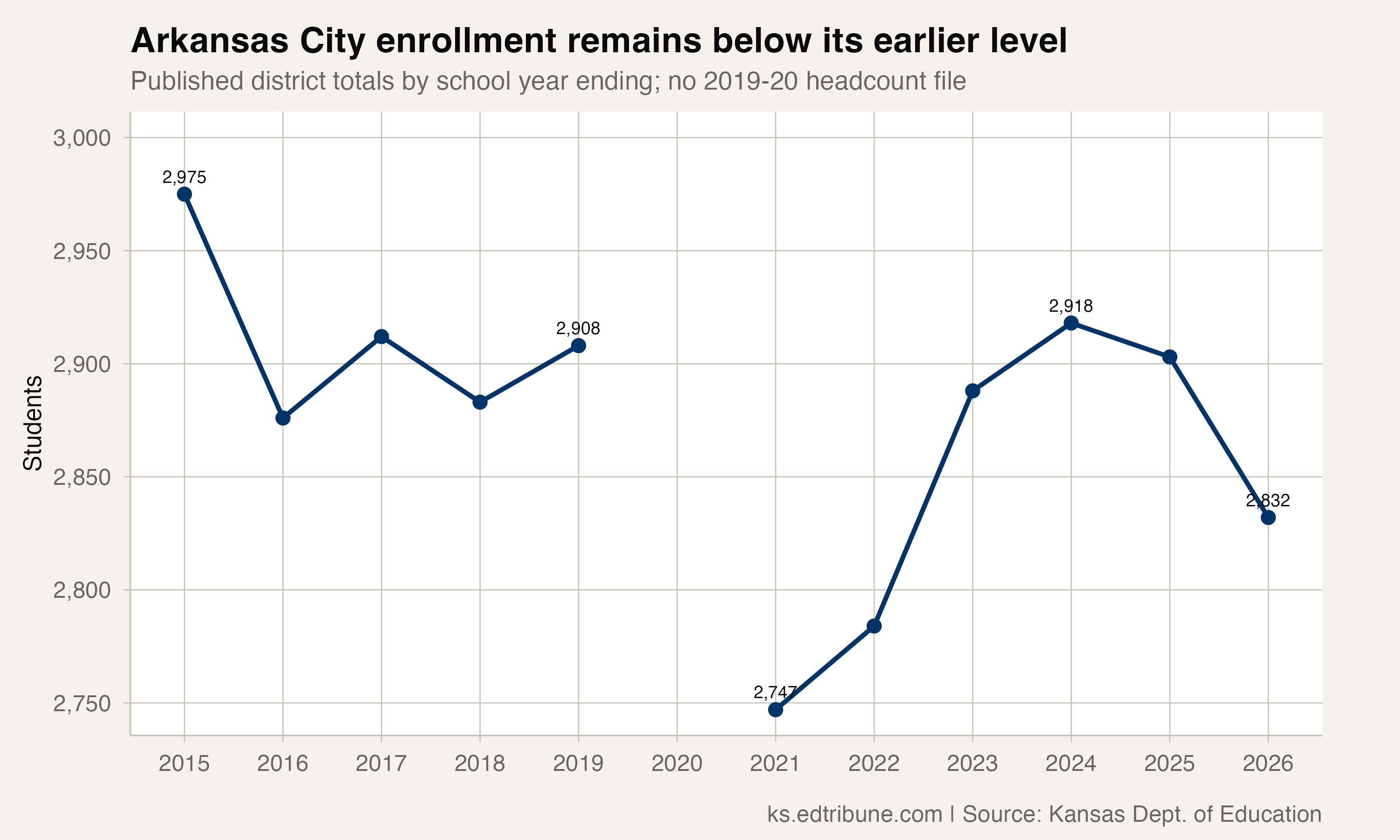
Arkansas City enrolled 2,832 students in 2025-26, down from 2,975 in 2014-15. That is a decline of 143 students, or 4.8%, across the available state record.
Growth after a low, then a recent decline
The district reached a low of 2,747 students in 2020-21. Enrollment then rose by 85 students, or 3.1%, through 2025-26. The latest year moved down by 71 students, or 2.4%.
The Kansas package has no headcount file for 2019-20, so the chart leaves a break between the surrounding years rather than presenting that gap as an annual change.
The state record establishes the movement but does not explain its causes. Nor does it show whether a bond project, program or leadership choice attracted or retained a family. Those are separate questions that require separate evidence.
For Pfannenstiel, the central issue is how the district makes decisions while several kinds of work converge. His time as interim superintendent reinforced, he said, that a choice in one part of the system can carry consequences across the rest.
"It reinforced for me how important it is to listen, ask questions, and make sure people understand the reasons behind the decisions we make," he wrote.
That emphasis also shapes the strategic-plan process he described. Pfannenstiel wants staff, families, students and community members involved, with buildings treated as one part of a broader agenda that includes instruction, staff support, safety and student opportunity.
His long tenure gives him familiarity with the district. It does not remove the need to earn trust in a new role. Pfannenstiel said the interim period reminded him how many people care about Arkansas City and want to be part of solutions.
The district's enrollment path adds practical weight to that approach. A system serving 2,832 students must plan for the students it has now while deciding how facilities, programs and staffing fit a record that has risen from its low but declined in the latest year.
Pfannenstiel's answer is to make those choices in public conversation with the people the district serves.
Enrollment figures come from the Kansas State Department of Education public enrollment record. The series has no headcount file for the school year ending in 2020. Pfannenstiel responded in writing and supplied the professional headshot preserved with the source packet.
Detailed code that reproduces the analysis and figures in this article is available exclusively to EdTribune subscribers.
Discussion
Sign in to join the discussion.
Loading comments...