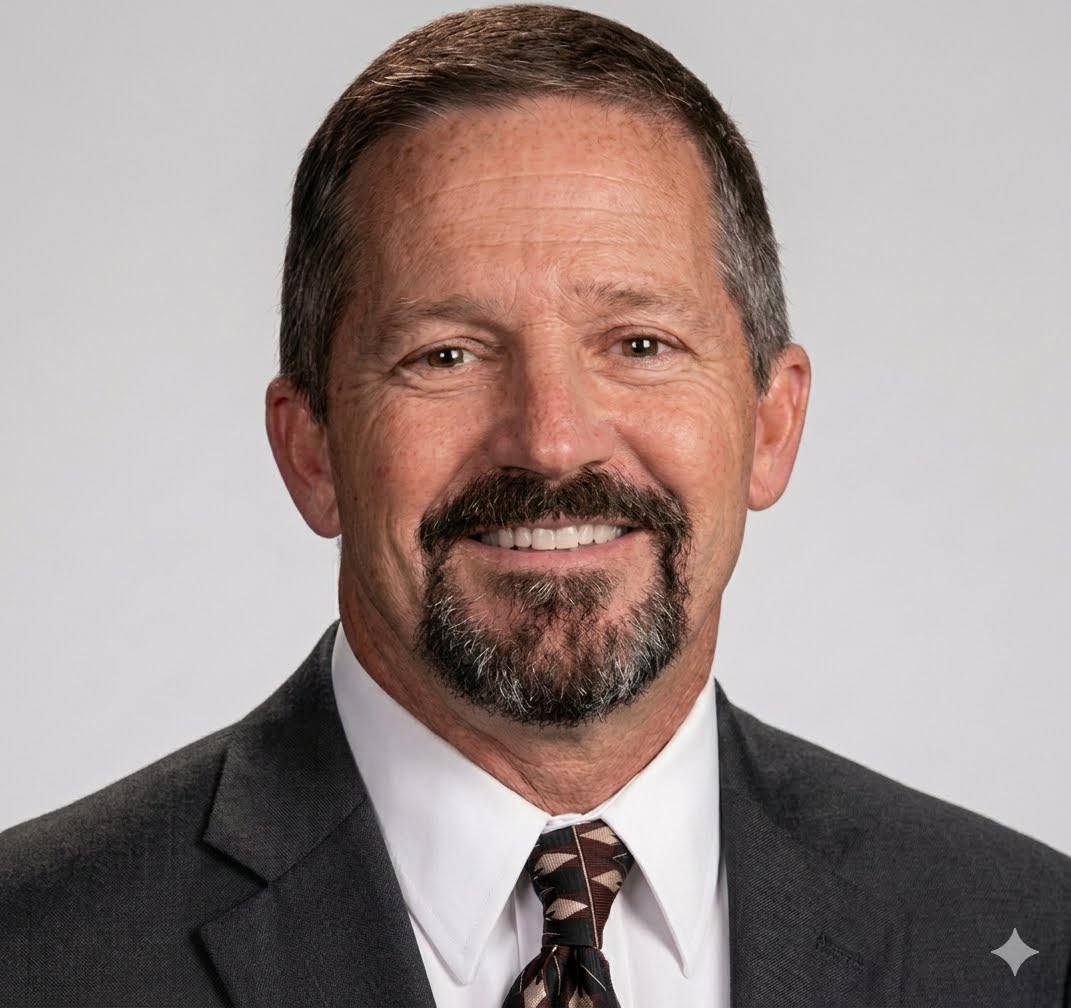
Stacy Graff became superintendent of Cheney↗ET USD 268 on July 1, and the number he says he watches most closely is one the state does not publish for his district.
"Realistically, we only look at K-1 numbers for our base of students expected for growth purposes," Graff wrote in response to questions from The KSEdTribune.
Kansas publishes one enrollment total for Cheney each year and withholds every grade-level count behind it, so the kindergarten and first-grade figures Graff tracks are the district's own. What the state does publish is the shape of the last eleven reported school years, and it is a shape that rewards exactly the kind of attention he describes: small, reversible, and easy to misread from any single year.
Cheney enrolled 771 students in 2025-26, the most recent school year in the state's published record. That is 32 students fewer than the 803 it enrolled in 2014-15, a decline of 4.0% across eleven reporting years. Both figures predate Graff. The published record describes the district he inherited, not the one he has been running since July.
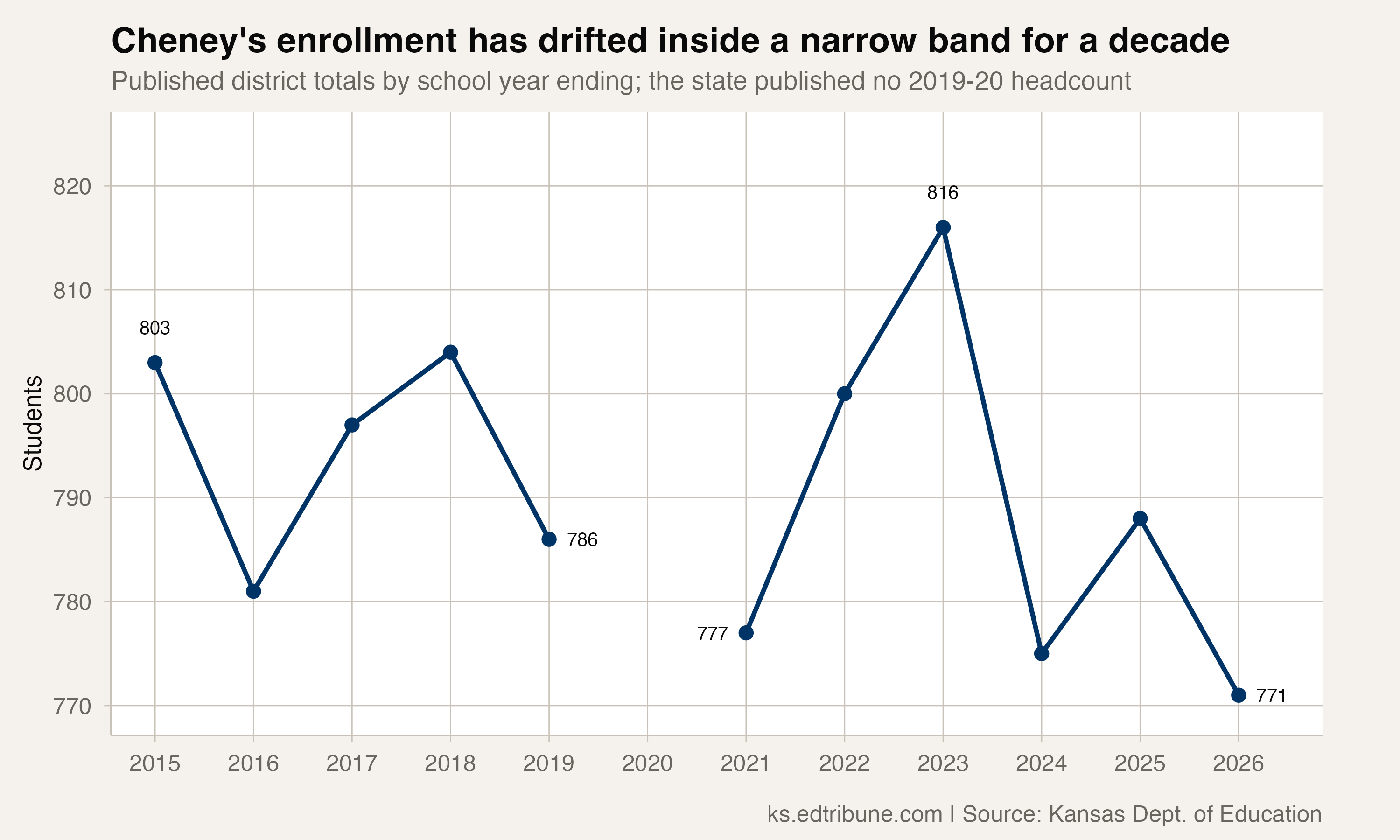
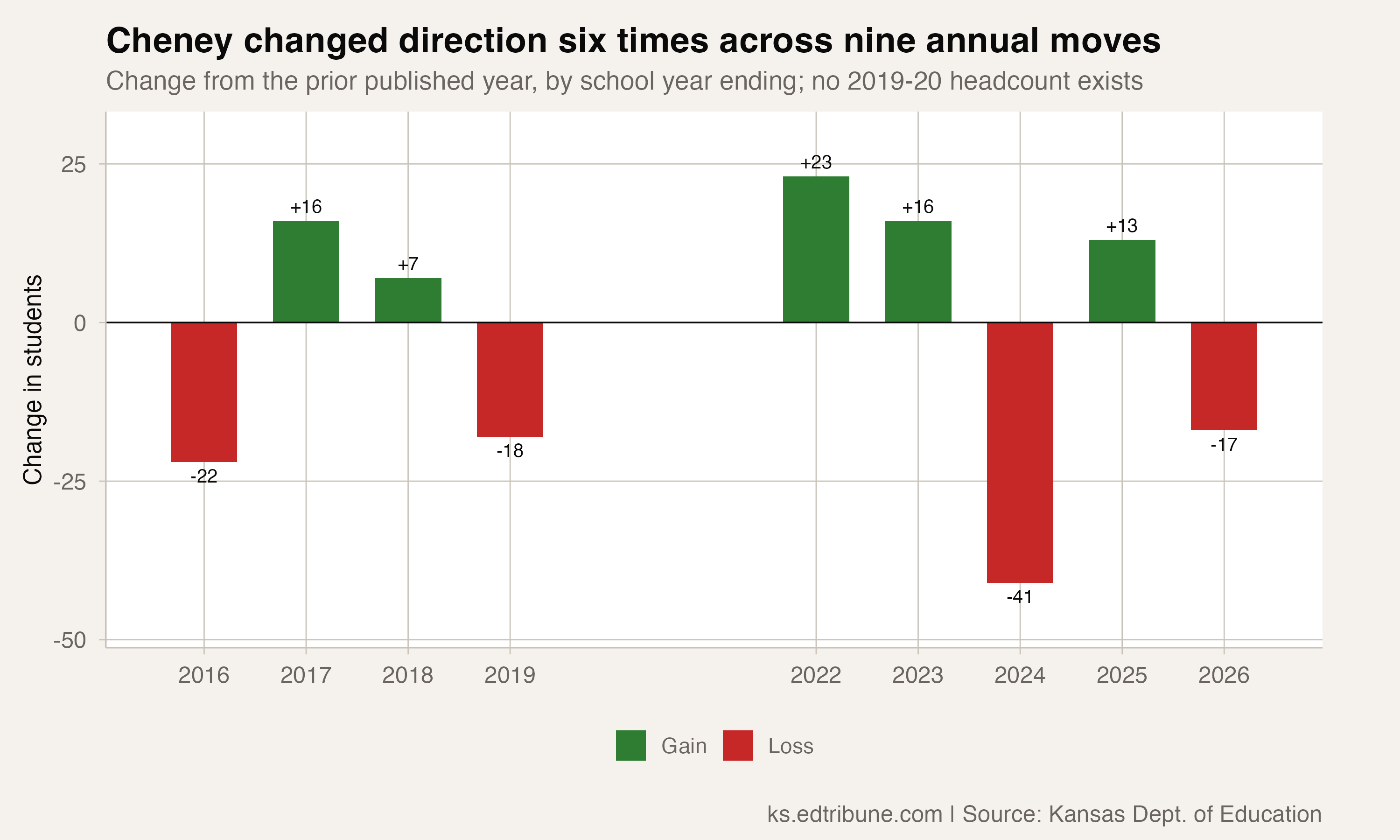
Between those endpoints the direction changed six times. Across the nine annual transitions the state's record supports, enrollment rose five times and fell four, and the entire eleven-year record spans 45 students, about 5.6% of the 2014-15 level. The largest single-year move anywhere in the window was 41 students. A district this size can give up a year's worth of ground and take most of it back before anyone finishes reacting.
What he brought with him
Graff came to Cheney from University Academy, a K-12 public charter school in Kansas City, Missouri, where he most recently served as assistant superintendent of human resources and operations. The approach he describes bringing to the role, though, traces further back, to years he spent earlier in his career in the Blue Valley school district in suburban Kansas City.
"My experience in the Blue Valley School District has strongly influenced how I am approaching this role," he wrote. He described Blue Valley as a district with high expectations and a deep commitment to continuous improvement, and said he sees the same commitment in Cheney.
What he wants to do with it is specific rather than sweeping. "I want to build upon the district's focus on formative assessment, continuous learning, and data-driven instruction while ensuring that those practices remain purposeful and connected to student outcomes," he wrote.
His stated first test for any decision is simpler. "My first priority will always be doing what is best for students," he wrote, and he tied the rest to the district's own stated purpose: "My leadership style is collaborative and grounded in our WHY: Educating Minds, Connecting Hearts, and Touching Lives."
That framing comes with a concrete instruction for staff. "I encourage our staff to be curious rather than judgmental and to seek to understand the cause of a challenge before prescribing a solution," Graff wrote. The question he wants asked is not "What have we always done?" but "What does our data tell us our students need, and how can we respond?"
The houses are there. The kindergartners are not yet.
The unresolved question in front of him is a local one, and he named it himself.
"Cheney is fortunate to have a strong sense of community, strong housing developments, and a tremendous level of community support," Graff wrote. "At the same time, we have not yet seen the corresponding influx of young families with kindergarten- and elementary-aged children that we might expect from that growth."
The state's enrollment record cannot settle that. It reports how many students the district enrolled, not who moved into town, when, or with children of what ages. It also will not answer the question quickly: a family that closes on a house this fall reaches a published state total only after the state's next release, if the count moves at all. Graff's own kindergarten and first-grade rosters will register it first, which is a plausible reason for a superintendent to watch a number the state does not print.
Pre-K will not do the job either, he said, because Cheney is not the only option nearby. "We wouldn't always equate lower Pre-K numbers with lower enrollment as we have a few other options for pre-k here," he wrote. The district's youngest grades are also its thinnest: the lowest counts, he wrote, "are consistently in the K-2 grades."
How the last decade compares
Cheney's 4.0% decline is close to what the state's own reporting districts recorded. Across the 285 Kansas districts with a published total in every one of those eleven years, enrollment fell 4.4%. But the typical district fared worse than either: the median of those 285 lost 7.9%, and 71.6% of them ended lower than they started.
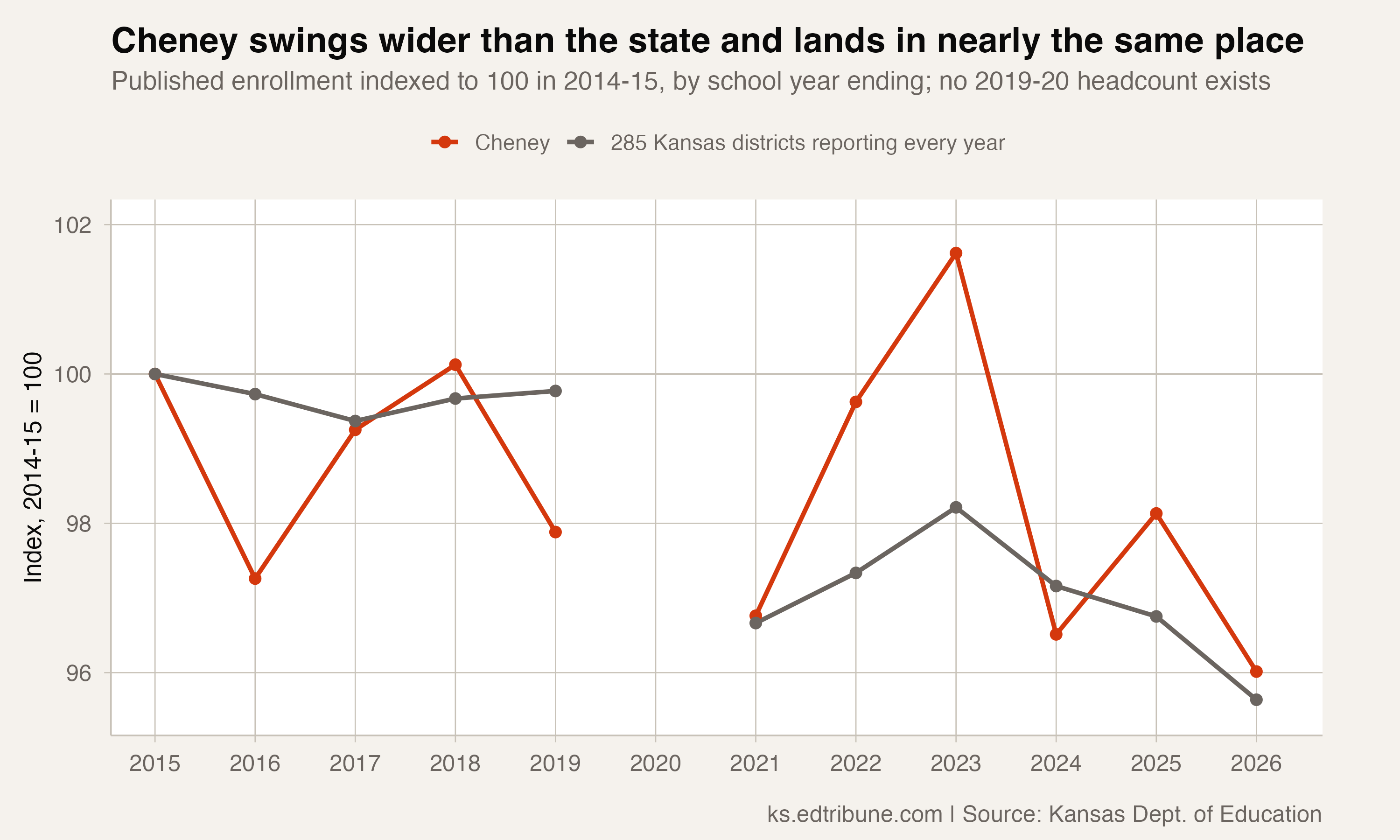
The two lines say something a single percentage does not. Cheney moves harder year to year than the state does, which is what happens when a district this size converts an ordinary graduating class into a visible percentage. It has ended up in almost the same place anyway.
One published measure moved further than enrollment did. The number of Cheney students qualifying for free or reduced-price lunch fell from 278 in 2014-15, 34.6% of the district, to 208 in 2025-26, 27.0%. It did not fall in a straight line, and it is a service category that overlaps with every other group the state reports, so it is not a poverty rate and does not belong on the same axis as anything else. What it does mark is a district whose composition has shifted while its headcount has not.
Intentional rather than complacent
Graff described his first year in terms of posture rather than initiatives. "In my first year, I would want us to be intentional rather than complacent," he wrote, adding that strong academic and activity results still require continually evaluating whether current practice is meeting the needs of every student.
He has been struck by the reception. Cheney's staff, he wrote, "have been incredibly welcoming to fresh perspectives and have embraced the challenge to 'Be the Change.'" The community response has been broader than he expected: "The number of community members who have personally stopped to offer encouragement, called, or sent emails wishing us well and offering their support has been both humbling and inspiring."
"My responsibility is to help bring those strengths together, protect what makes Cheney special, and continually move us forward so that the next generation of students benefits from the work we do today," he wrote.
The published record gives him a district that has not shrunk much and has not grown either, holding a band about 45 students wide for eleven reported years while most of Kansas gave up more ground. Whether the housing Graff describes turns into students is the one thing that record cannot tell him, and the first place it will show is the kindergarten roster he is already counting.
Enrollment figures come from the Kansas State Department of Education public enrollment record. The state published no district headcount for the school year ending in 2020, and it withholds every grade-level count for this district. Stacy Graff responded in writing and supplied the professional headshot.
Detailed code that reproduces the analysis and figures in this article is available exclusively to EdTribune subscribers.
Discussion
Sign in to join the discussion.
Loading comments...