
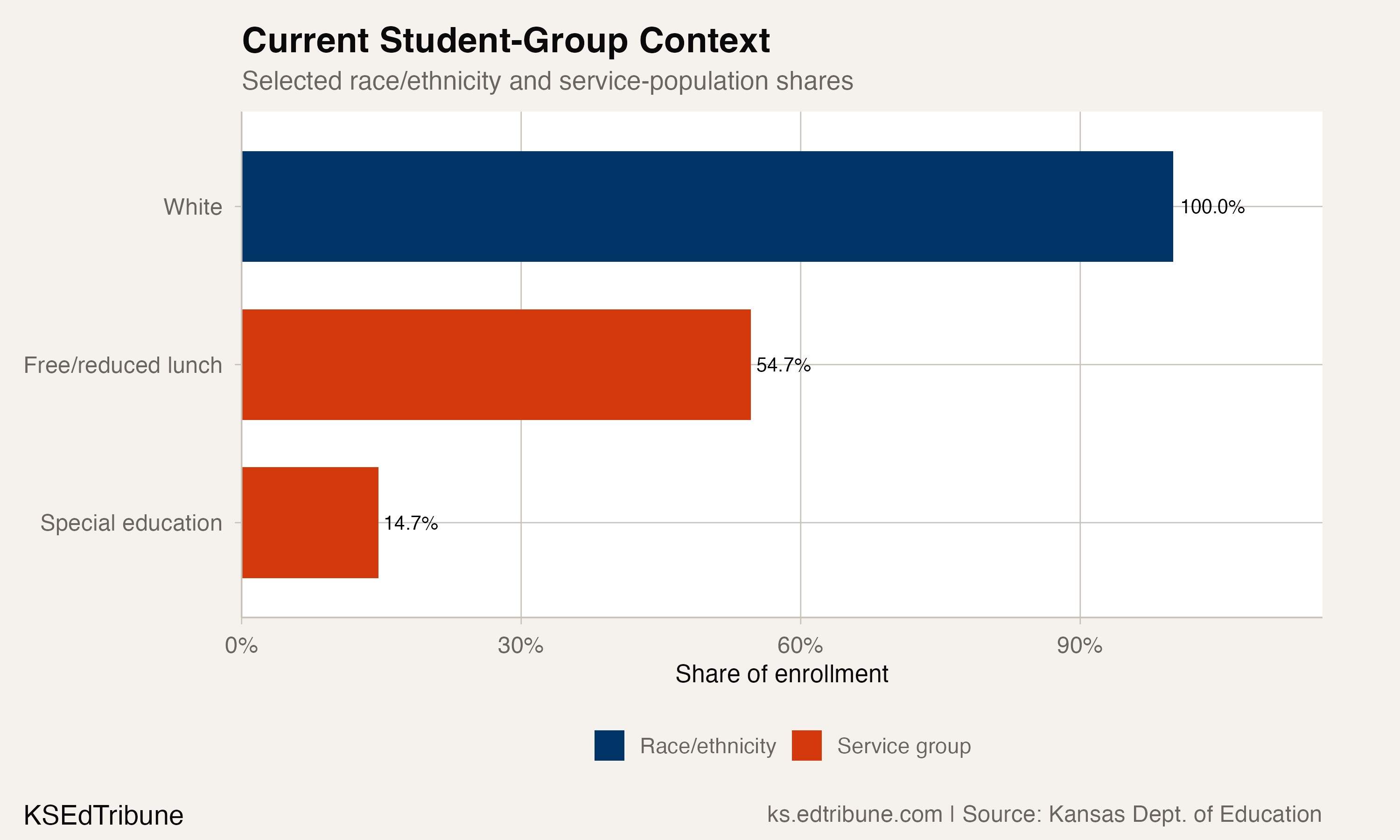
Correction (July 24, 2026): An earlier version of this article understated West Franklin's enrollment and described 2026 as the district's low point. It reported 525 students and a one-year decline of 35 students. Those figures came from a data-processing error that rebuilt district totals by adding up grade-level rows, which the Kansas State Department of Education redacts whenever a count is small. The published KSDE headcount is 605 students in 2026. That is above the district's 2015 count and below its 2022 peak, so 2026 is not a low point, and the section describing it that way has been rewritten. The one-year change is a decline of 30 students. The free or reduced-price lunch share has been corrected. The special education share has been removed: KSDE redacts this district's special education count, so no share can be reported. Both charts were rebuilt.
Paige Prouty is stepping into the West Franklin MS/HS principal role with an insider's view of what she wants to protect.
Asked what she wants to carry forward, Prouty pointed first to literacy and instruction.
"One of the biggest things I want to carry forward is the work we've done around literacy and high-quality instructional practices," Prouty said in a written response to EdTribune. "Over the past several years, our district has invested significant time and effort into improving instruction and ensuring students have the skills they need to be successful."
She also named staff retention as part of the leadership transition.
"We are fortunate to have teachers and staff members with years of experience -- not only in education, but specifically at West Franklin," she said. "That institutional knowledge and commitment to our students is one of our greatest strengths."
A Small District With Year-to-Year Swings
West Franklin↗ET enrolled 605 students in 2026. That is 28 more than the district counted in 2015, and 30 fewer than a year earlier, a 4.7% one-year drop. Enrollment has moved up and down in a narrow band for a decade, with a high of 638 students in 2022.
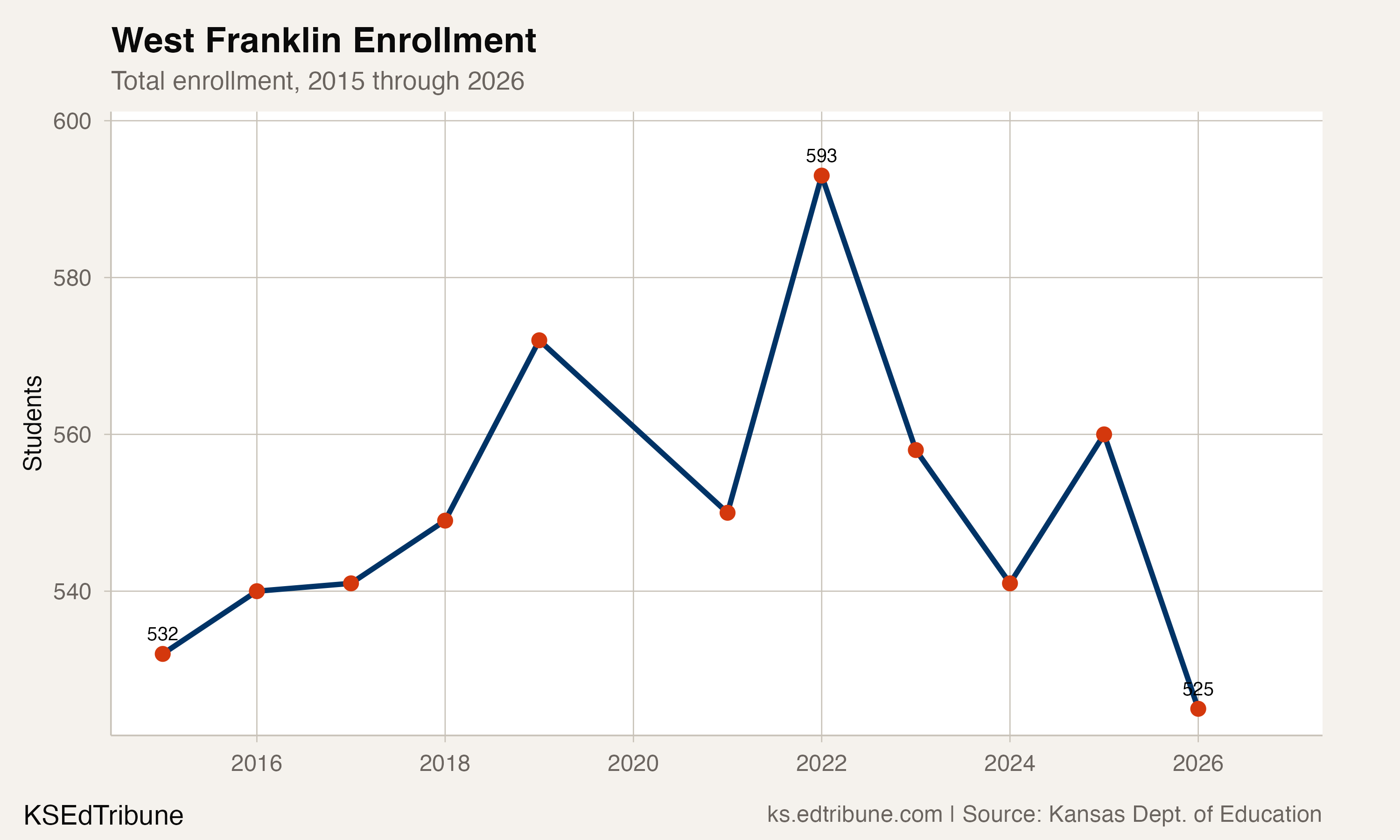
In a small district, that kind of movement is suggestive context for conversations about staffing, scheduling, extracurriculars, and the breadth of options a school can offer. In 2026, 50.2% of West Franklin students were eligible for free or reduced-price lunch, according to Kansas State Department of Education reports. KSDE redacts this district's special education count under federal privacy rules, so no district special education share is available.
Prouty did not frame the enrollment picture as a reason to retreat. She said the district is looking at ways to expand options while keeping the community identity intact.
"We have begun exploring opportunities to expand educational options for students through both hybrid and fully online learning pathways," Prouty said. "Our goal is to meet the needs of today's students and families while maintaining the strong sense of community that makes West Franklin unique."
The Relationship Advantage
Prouty described small-district leadership as relational before it is managerial.
"I truly believe relationships are the most important driving force in education," she said.
In a smaller district, she said, staff know students beyond grades and test scores. They know activities, interests, and often families. That knowledge changes how adults support students when school gets difficult.
"When students know you genuinely care about them as people, it becomes much easier to build trust and help them see the value of their education," Prouty said.
The part of the job she wants to put her own hand on is community tradition: increasing involvement, celebrating what makes West Franklin distinct, and giving students more ways to connect with the people and organizations around the school.
"When schools and communities work together, students benefit," Prouty said.
For West Franklin, the leadership transition is not a clean break from the previous chapter. It is an attempt to hold onto the pieces Prouty thinks are working -- literacy, staff experience, relationships, and community pride -- while absorbing year-to-year enrollment swings and changing family needs.
Detailed code that reproduces the analysis and figures in this article is available exclusively to EdTribune subscribers.
Discussion
Sign in to join the discussion.
Loading comments...