Retraction, July 24, 2026. On May 25, 2026, The KSEdTribune published an article headlined "Kansas Has Lost 22 School Districts in 21 Years." It reported that four Kansas school districts had closed this year and that rural districts were disappearing at a pace the state had not seen since the 1960s. Both claims were false, and the enrollment figures underneath them were wrong. We retract the article in full.
Burrton, Cedar Vale, Lewis and Triplains are open
The article named four districts and said each had shut down: Burrton, Cedar Vale, Lewis and Triplains. It said each was down to 10 or 12 students when the lights went off, and it opened with Burrton as its image of a school district going dark.
None of that happened. All four districts are open and enrolling students in 2025-26. The headcounts the Kansas State Department of Education publishes for them are:
- Burrton, 101 students
- Cedar Vale, 118 students
- Lewis, 112 students
- Triplains, 77 students
Burrton's real record is a district that has been slowly getting smaller, not one that closed. It enrolled 266 students in 2005, 223 in 2020, 109 last year and 101 this year. That is a hard trend for a small community, and it is a completely different fact from the one we printed.
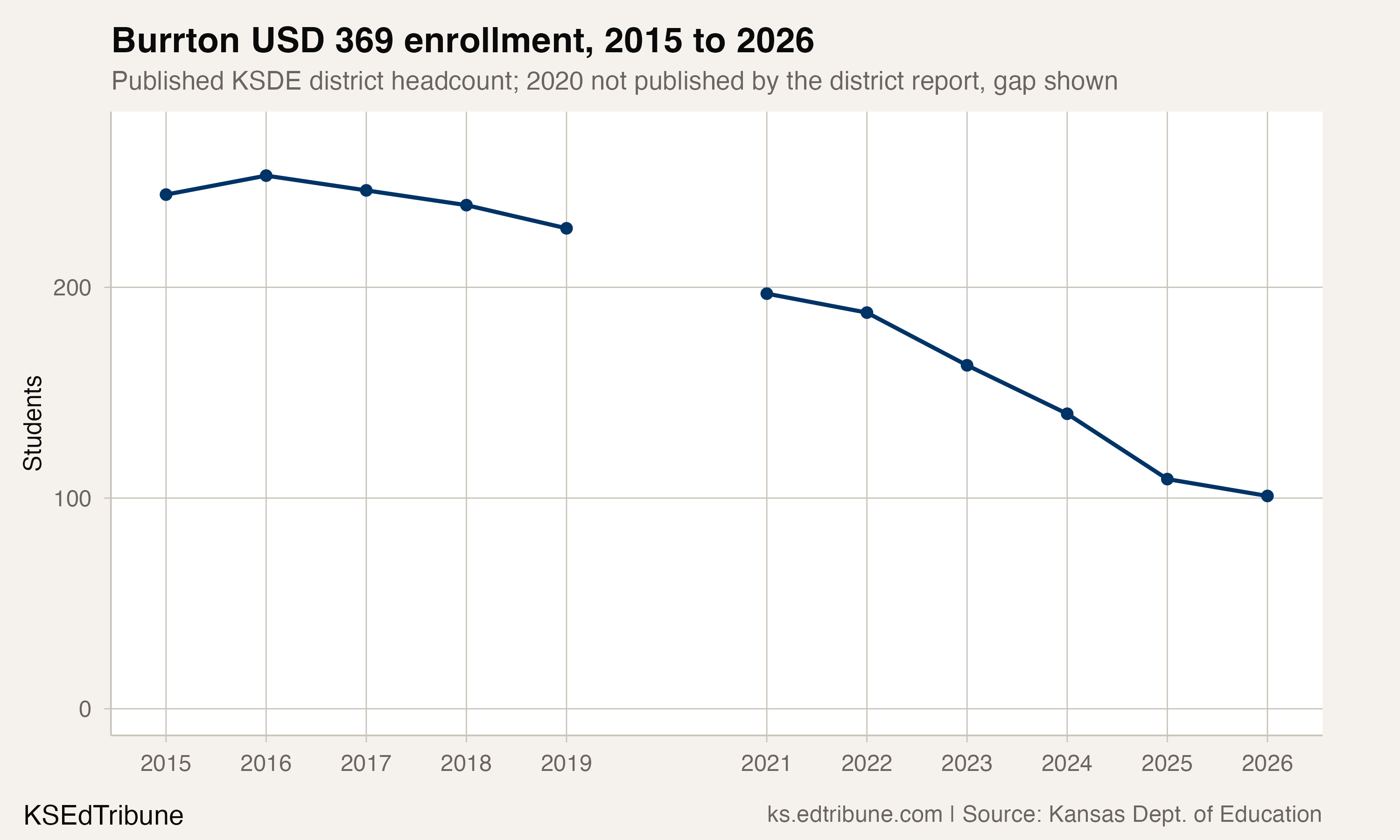
We are sorry. We told readers, including the families, staff and neighbors of these four districts, that their schools no longer exist. They do, and students are in them right now. We were wrong about four operating school districts, and that is the most serious kind of error a publication can make about a community.
Where the false numbers came from
The enrollment totals in the article were not the totals Kansas publishes. We built them ourselves, by adding up each district's grade-by-grade enrollment rows.
That method does not work on this source. Kansas withholds any row that would expose a count of fewer than 10 students, as federal student privacy law requires. In a district of a hundred students spread across every grade from kindergarten through senior year, most grade rows fall below that threshold and are withheld. Adding up only the rows that survive treats every withheld student as though that student were not there. In the smallest districts almost nothing survives, so a district of 101 students came out of our arithmetic as 10.
That is how four operating districts appeared to us to have shrunk to a handful of children and then vanished. Those students were never missing from Kansas. They were missing from our method. KSDE publishes district enrollment headcounts without that suppression, and we did not use them.
The same error produced false enrollment for three more named districts. The article said Wheatland, Macksville and Chase-Raymond each enrolled exactly 10 students, and presented them as the next districts likely to go. Their published 2025-26 headcounts are 97, 162 and 104. We apologize to those three communities as well.
The central finding was backwards
The article argued that Kansas is in an accelerating wave of rural school closures. The published record says close to the opposite.
Kansas had 301 school districts in 2005 and has 285 today, a net loss of 16 over 21 years, not the 22 in our headline. Twenty-five districts have left the state's rolls since 2005, and 24 of them went between 2006 and 2012. Exactly one has closed in the 13 years since. None closed in 2025-26.
So the article's closing line, that four districts gone in a single year was a pace Kansas had not seen since the legislative consolidation era of the 1960s, is the reverse of what the data shows. Kansas consolidation largely stopped after 2012.
What happens next
We are not putting corrected figures in place of the rest of the article. The counts of districts under 100 students, the size distribution, the tally of districts that lost more than half their enrollment, and every chart drawn from them all came through the same flawed sum. They are withdrawn, and the charts have been deleted from this page rather than left standing under a correction banner.
There is a real story in this data, and it is not the one we published: a wave of Kansas consolidation that ran through 2012 and then essentially stopped, alongside small rural districts that keep getting smaller without closing. We intend to report that properly, in a separate article, built on the enrollment headcounts KSDE publishes through its Data Central portal rather than on sums we assemble ourselves.
This article also carried a fact-check, and that fact-check tested the article's numbers against the same flawed sums that produced them, which is not a test at all. We have rewritten it to verify the retraction against published KSDE headcounts, and we are changing how those checks are run.
Readers who relied on the original article should disregard it.
Detailed code that reproduces the analysis and figures in this article is available exclusively to EdTribune subscribers.
Discussion
Sign in to join the discussion.
Loading comments...