In this series: Kansas 2025-26 Enrollment.
Correction, July 24, 2026. This article has been substantially rewritten and every enrollment figure in it has changed. Two errors sat underneath the original version. First, the district totals we used were built by adding up grade-level rows, and Kansas withholds any row covering fewer than 10 students, so the totals were short in every district and every year. Second, and more serious, the original version reported statewide Hispanic enrollment counts, shares, and a 22-year trend. Those numbers were assembled the same way, from a source where KSDE published a Hispanic count for only 16 of the state's 285 districts in 2025-26. Adding up the districts that report and dividing by a complete enrollment total treats every withheld count as zero. Those statewide figures are withdrawn, not corrected, and no replacement is offered. Gone with them: the count of majority-Hispanic districts in Kansas, the ranking of the state's most Hispanic districts, the corridor-wide white enrollment series, and three charts. What remains is what KSDE actually published for these districts.
In Liberal↗ET, 87 out of every 100 public school students are Hispanic. In Dodge City↗ET, 83. In Garden City↗ET, 72. These are not border towns. They sit in the southwest corner of Kansas, 300 miles from the nearest point of entry, surrounded by feedlots and wheat fields. The force that remade them was not proximity to Mexico but proximity to cattle: four massive beef-processing plants that, over four decades, recruited a workforce from Latin America and, in doing so, built a student body that looks nothing like the rest of the state.
Across the three districts, 14,768 of 18,491 students are Hispanic, a combined 79.9%. At the start of the state's published record, in 2004-05, the same three districts enrolled 11,150 Hispanic students out of 18,030, or 61.8%. The corridor did not fill up with new arrivals. It stayed roughly the same size and changed who was in it.
The Golden Triangle by the numbers
The transformation started in the early 1980s, when Iowa Beef Packers (now Tyson Foods) opened what was then the world's largest beef-processing facility near Garden City, and Cargill and National Beef expanded operations in Dodge City. Liberal followed shortly after. The plants needed labor. Unemployment in southwest Kansas was low, and most of the existing Anglo population was uninterested in the work. So the companies recruited, first from Southeast Asia, then from Mexico and Central America.
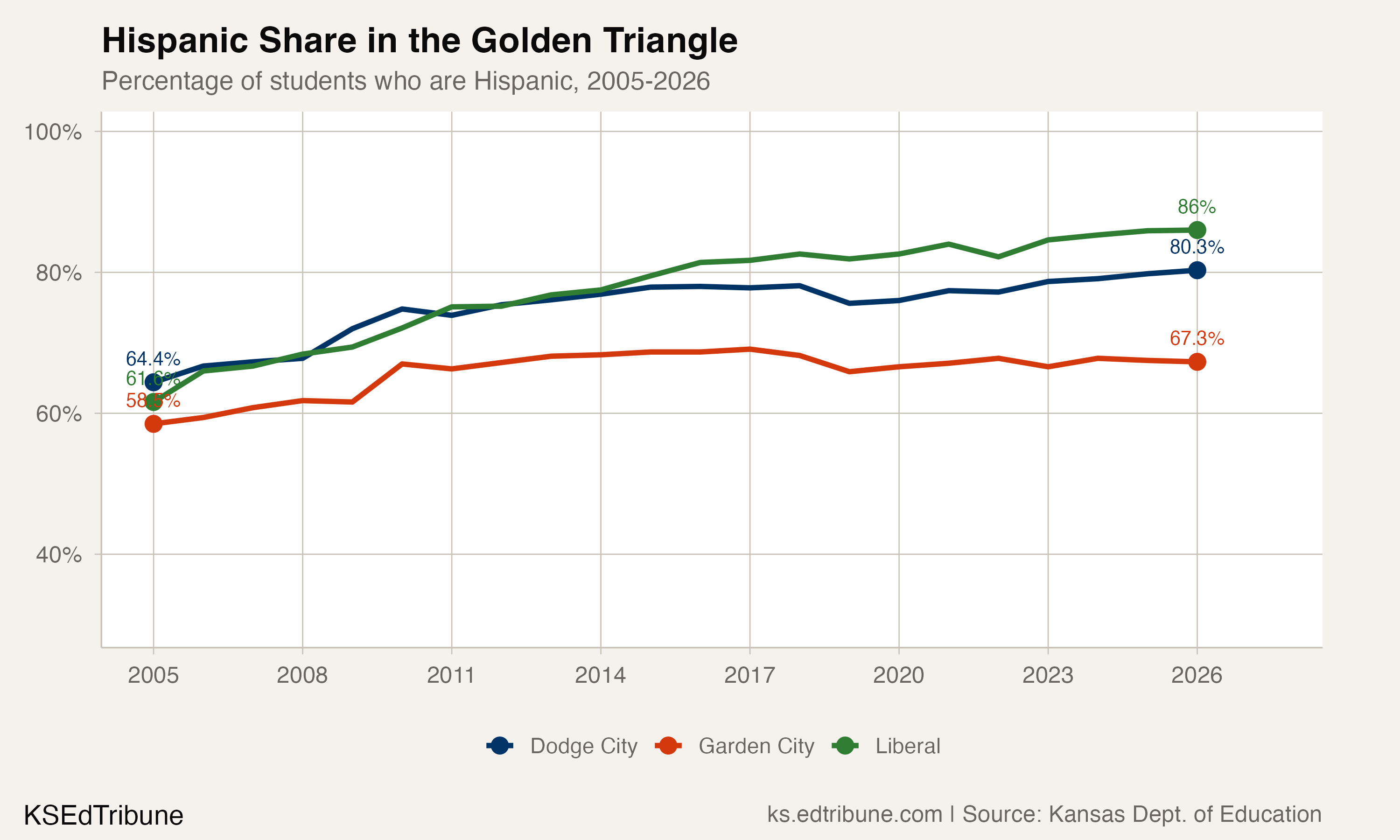
The enrollment counts capture the second and third generation of that recruitment, and the three districts moved at different speeds. Liberal climbed the most, from 63.1% Hispanic in 2004-05 to 87.4% in 2025-26, a gain of 24.3 percentage points and 1,166 students. Dodge City went from 63.6% to 82.6%, adding 2,017 Hispanic students, the largest absolute increase in the corridor. Garden City rose from 59.8% to 72.1%, adding 435. Between them the three districts added 3,618 Hispanic students over two decades.
The chart shows gaps. KSDE withholds a district's race count in any year the numbers get small enough to identify individual children, and each of the three districts has three such years in the 22-year record. Those years are left out rather than filled in.
Outside the corridor, the districts KSDE does publish a count for show the same pattern reaching east and north. Ulysses↗ET, 50 miles south of Garden City, is 71.5% Hispanic, with 1,046 of its 1,463 students. Kansas City↗ET reports 12,266 Hispanic students out of 21,129, or 58.1%. Emporia↗ET is at 48.0%. How many Kansas districts are majority Hispanic is not a question this source can answer, because most districts have no published count at all.
A corridor that outgrew the state, then turned with it
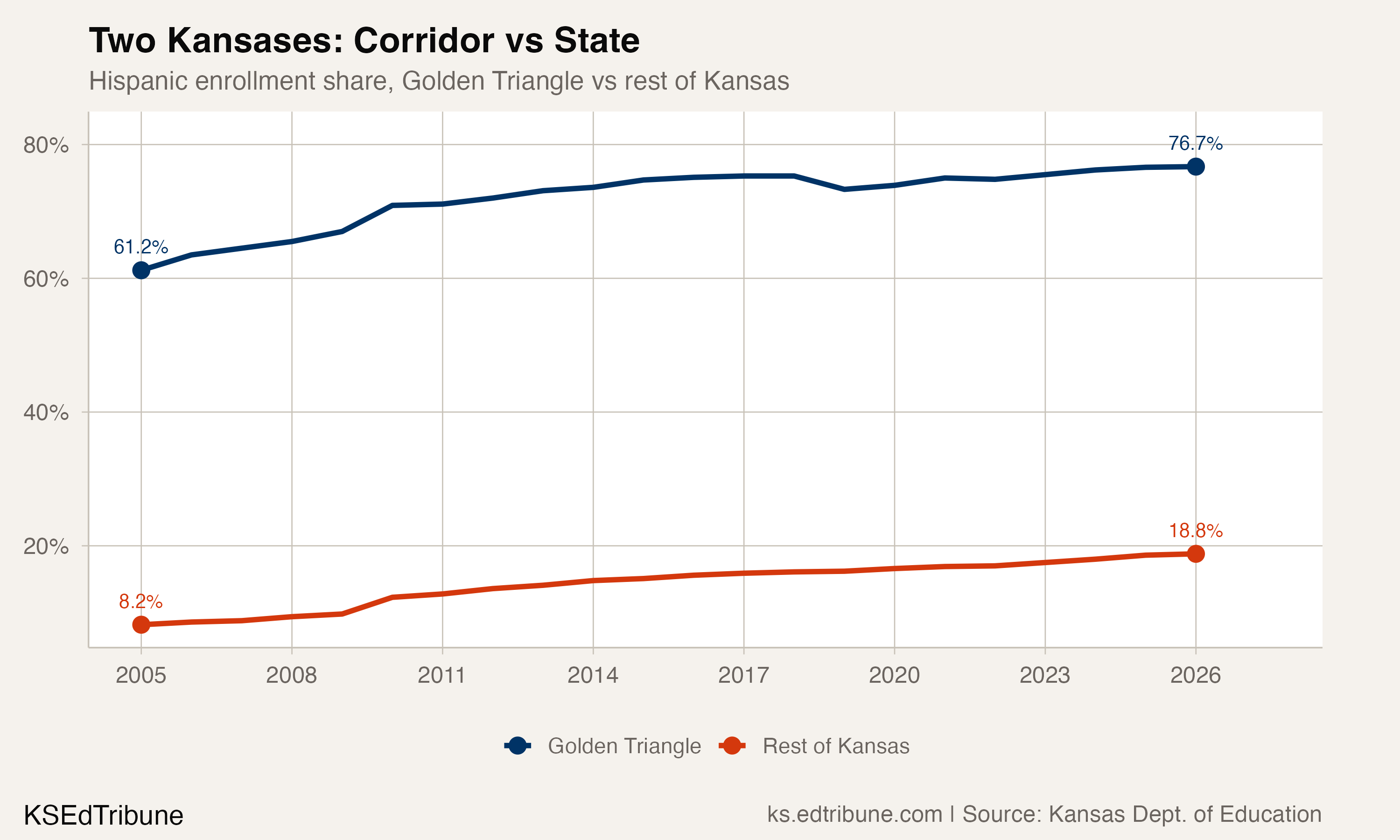
Kansas enrollment peaked at 492,906 in 2014-15 and has since fallen to 471,334, a loss of 21,572 students. The corridor has not been immune. Combined enrollment across the three districts peaked at 19,816 in 2015-16 and stands at 18,491 now, down 1,325. But measured across the full 22-year record, the corridor gained 461 students, up 2.6%, while the state ended the same stretch 21,572 students smaller than its own peak.
That is the practical difference the plants made. In a part of Kansas where districts have been consolidating for a generation, three of them are roughly the size they were in 2005.
The other side of the ledger
Enrollment in the corridor did not grow much, so a rising Hispanic share means a falling white one. How far it fell is mostly not something KSDE prints. Dodge City has no published white-student count in any of the 22 years. Liberal has two. Garden City is the exception, with eight published counts spread across the period, and they tell the story clearly enough: 2,140 white students out of 7,405 in 2005-06, or 28.9%, and 1,180 out of 6,850 in 2023-24, or 17.2%. That is 960 fewer white students and a drop of 11.7 percentage points in the years KSDE reported both ends.
Some of that reflects the rural depopulation hollowing out western Kansas generally. But in a 2024 KCUR investigation, reporters found that the corridor's story is distinct: while surrounding counties that did not attract immigrant labor are projected to lose half their population over 50 years, Finney County (Garden City) is projected to grow 18%. The plants created a demographic engine that reversed the rural drain, but only for the communities that had them.
"We need each other." -- Dodge City community members, as reported by Our Towns Foundation
That phrase, repeated to journalists by both longtime residents and newer arrivals, captures the economic bargain at the heart of the corridor. The plants provide year-round wages that make Dodge City a permanent home rather than a seasonal stop. The workforce, in turn, keeps open a school system that would otherwise face the same consolidation pressures as its neighbors.
What the funding formula sees
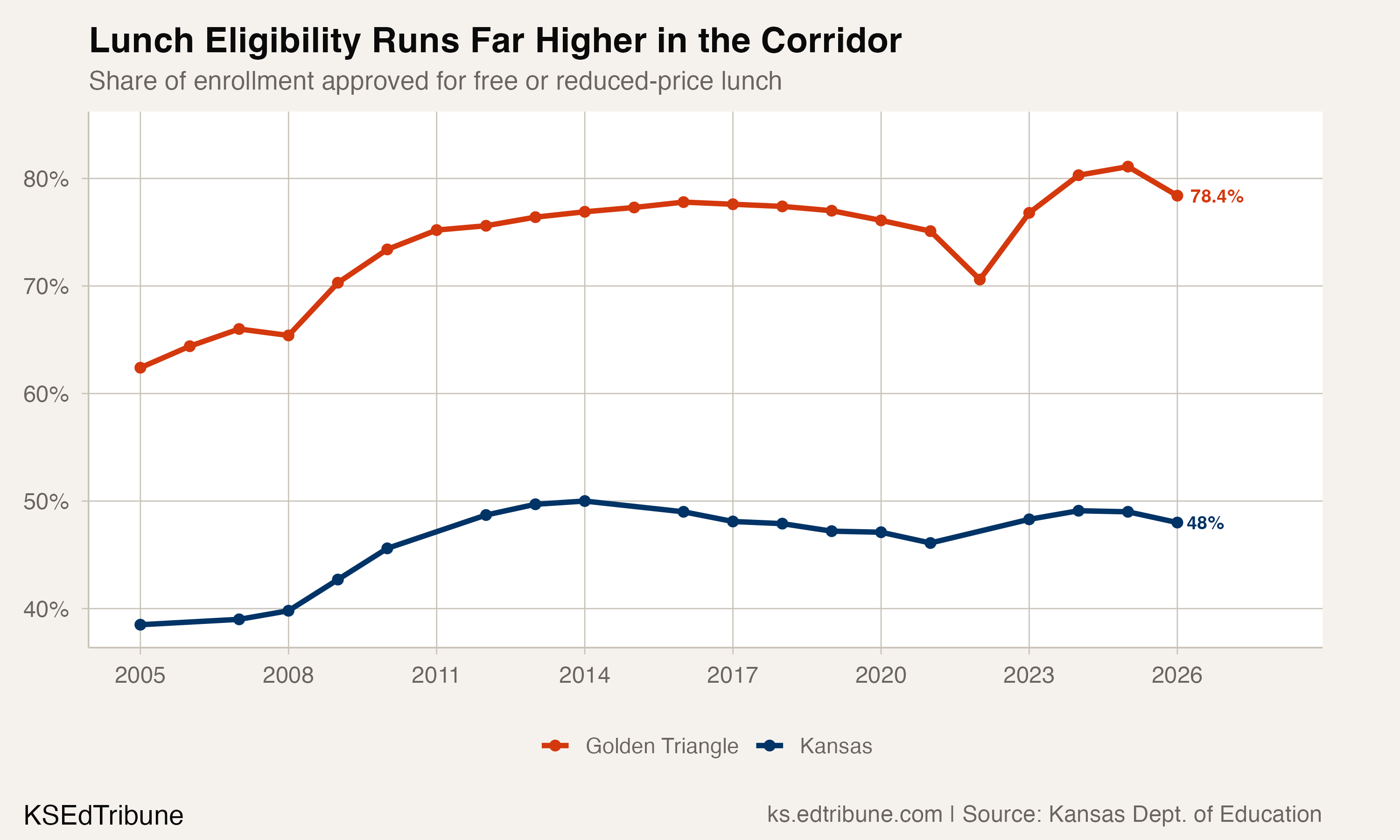
The corridor districts carry a double funding weight that most Kansas districts do not. Better than three-quarters of their students qualify for free or reduced-price lunch, 78.4% in 2025-26 against a state figure of 48.0%. And the concentration of students learning English generates additional bilingual weighting under the Kansas school finance formula, which multiplies eligible FTE enrollment by a factor of 0.395, generating supplemental state aid.
Statewide, bilingual weighting generates approximately $51.5 million in state foundation aid and $16.9 million in local option budget transfers. A task force convened in 2025 examined whether to restructure the formula, including a two-tier model that would provide higher multipliers for "newcomers," students in the United States less than one year. No changes have been adopted.
Dodge City's experience illustrates the scale of demand. USD 443 enrolls 7,078 students, 85% of whom are non-white, with nearly half classified as English language learners. In August, 20 to 30 new immigrant students typically arrive, many from Guatemala with limited prior formal education. The district passed an $85 million bond in 2015 with 58% approval, a notable margin in a conservative community, to upgrade facilities.
Asked for the district's perspective on the demographic and funding picture, USD 443 Superintendent Jason Scheck framed enrollment numbers as one measure among many. "While enrollment figures provide one measure of our district, they do not fully capture the strengths of our students, the dedication of our staff, or the commitment of our families to student success," he said in a written statement. "The diversity of our students is an important part of who we are as a district, and our staff works each day to meet students where they are and help them succeed." Scheck pointed to the 2015 bond as evidence of the community's underlying commitment, calling it a "shared commitment to providing quality educational opportunities for students in Dodge City."
The corridor under pressure
Two forces now press on the corridor from opposite directions. The first is the broader Kansas enrollment decline, which has taken 1,325 students out of the corridor's combined headcount since 2015-16, cutting into funding even as service demands hold steady. The second is federal immigration enforcement, which arrived in southwest Kansas in 2025 and has intensified in 2026 under expanded 287(g) agreements between ICE and local law enforcement agencies.
In Dodge City, despite 59% of the voting-age population being Hispanic, only one Latino has won election since 2000, and the school board and city commission have zero Hispanic members. This representation gap means the community most affected by enforcement-related enrollment volatility has the least say in how schools respond.
It is too early to know whether immigration enforcement will measurably reduce corridor enrollment. The 2025-26 count, collected in September 2025, predates the most active enforcement period. But even without enforcement, the corridor faces a structural question: the meatpacking industry that built these communities is contracting nationally, with Cargill and Tyson announcing plant closures and capacity reductions in other states. Southwest Kansas has not yet been directly affected, but the industry's long-term trajectory has shifted.
What to watch
The 2026-27 count will be the first to fully capture any enforcement-related effects. If the corridor's enrollment drops while the rest of the state holds steady, it will suggest that federal policy is doing what rural depopulation could not: reversing the demographic engine that kept southwest Kansas from shrinking. If enrollment holds, it will suggest that the community's roots, now two and three generations deep, have grown past the point where policy alone can dislodge them.
Either outcome carries fiscal implications well beyond Finney, Ford, and Seward counties. The bilingual weighting that flows to Kansas districts is not just a line item. A large share goes to the corridor, where it funds the teachers, translators, and counselors who keep more than 18,000 students in school in communities where the household next door often speaks a language other than English.
At 79.9% Hispanic, the Golden Triangle's transformation is generational. The Cargill plant in Dodge City still runs three shifts. The apartment complexes near the National Beef facility in Liberal still house families with children enrolled at Southwest Elementary. What has changed is not the corridor's identity but the ground beneath it: an aging industry, a tightening border, and a state funding formula written back when the corridor was 61.8% Hispanic rather than 79.9%.
Detailed code that reproduces the analysis and figures in this article is available exclusively to EdTribune subscribers.
Discussion
Sign in to join the discussion.
Loading comments...