In this series: Kansas 2025-26 Enrollment.
Correction, July 24, 2026: An earlier version of this article understated Kansas enrollment in every year it reported. The Kansas State Department of Education suppresses any published figure covering fewer than 10 students, and the district totals behind the original version had been rebuilt by adding up those partly suppressed rows, which silently dropped the hidden students. Every number below has been recalculated from the district headcounts KSDE publishes in full. Statewide 2025-26 enrollment is 471,334, not 447,803, and the losses reported here are smaller than the ones originally published. The article's finding, that Kansas has not recovered any of its pandemic enrollment loss, is unchanged.
In most states, the pandemic was a dip. Kansas schools lost 15,667 students between 2019-20 and 2020-21, a 3.2% drop that aligned with the national pattern of families pulling children from public education during COVID-19. What followed was supposed to be a recovery. Two years of gains in 2021-22 and 2022-23 added back 7,633 students, enough to suggest the bottom had been found.
It had not. Since 2023, Kansas has lost another 12,734 students across three consecutive years of decline. The state now sits at 471,334 students, 20,768 below where it stood in 2019-20 and 4.2% smaller than it was before a single mask was worn in a Kansas classroom. Measured against the state's actual high-water mark, 492,906 students in 2014-15, the shortfall is 21,572. The pandemic did not cause a temporary disruption. It accelerated a demographic shift that was already slowing growth before 2020, and the resulting decline shows no sign of leveling off.
Nearly six in 10 districts are worse off than during COVID
The most striking finding in the data is not how few districts have recovered. It is how many have fallen further. Of the 285 Kansas districts that reported enrollment in both the last pre-COVID year and 2025-26, just 90, or 31.6%, have returned to their 2019-20 levels.
But the recovery rate understates the problem. A full 169 districts, 59.3% of the total, now enroll fewer students than they did at the worst point of the pandemic in 2020-21. These districts did not merely fail to bounce back. They have been losing students at a rate that makes the COVID year look like a plateau, not a trough.
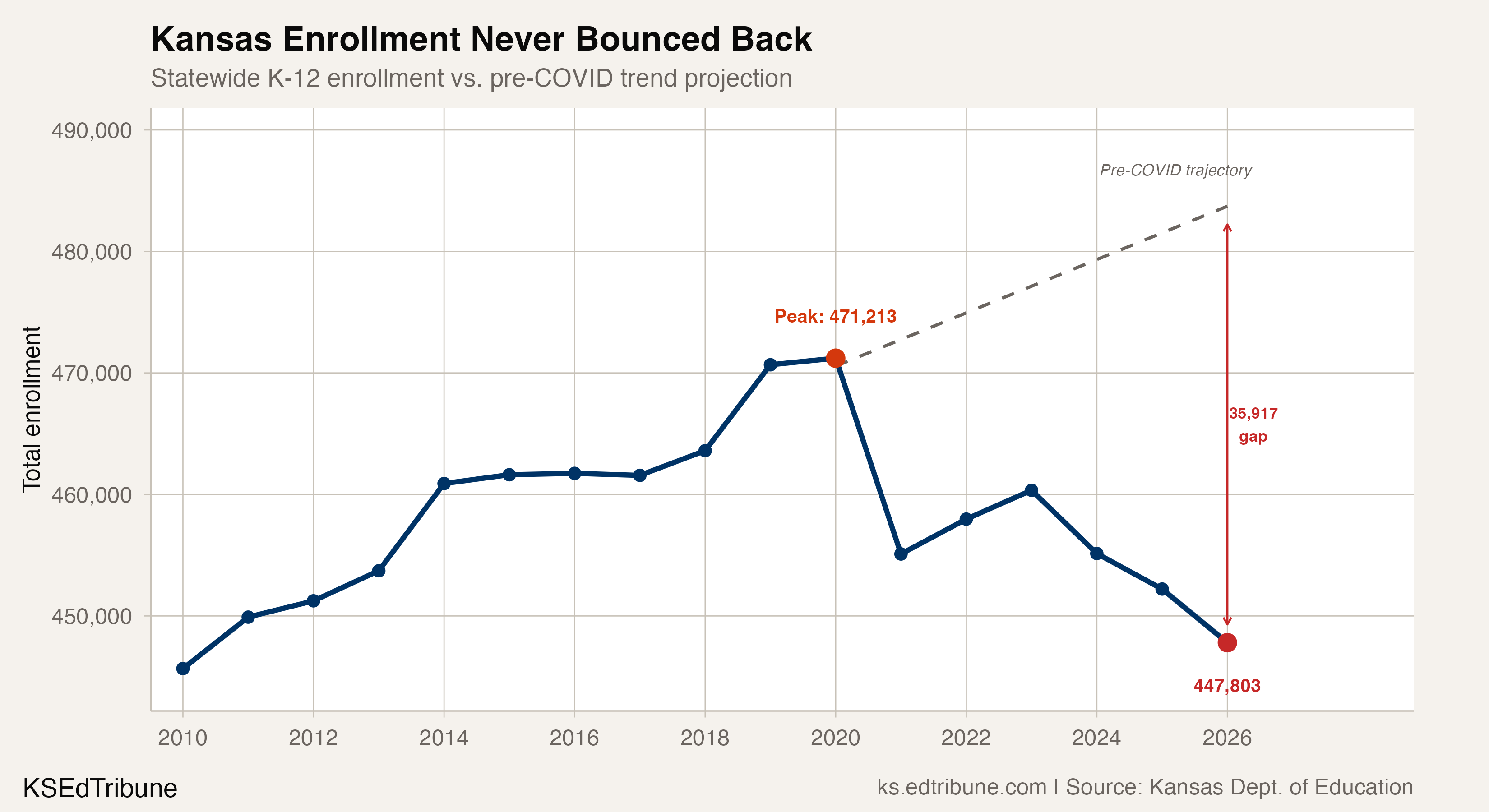
The gap between where Kansas enrollment would be on its pre-COVID trajectory and where it actually is has widened to 19,754 students. That number represents a combination of students who never returned to public school and students who were never born. Kansas's birth rate hit 11.6 per 1,000 in 2023, the lowest since the state began keeping records in 1912.
The brief recovery that wasn't
The year-over-year pattern makes the false recovery visible. Kansas added 3,308 students in 2021-22 and 4,325 in 2022-23. Those two years were the only gains in the post-COVID period. What followed erased them and then some: losses of 5,210 in 2023-24, 2,027 in 2024-25, and 5,497 in 2025-26.
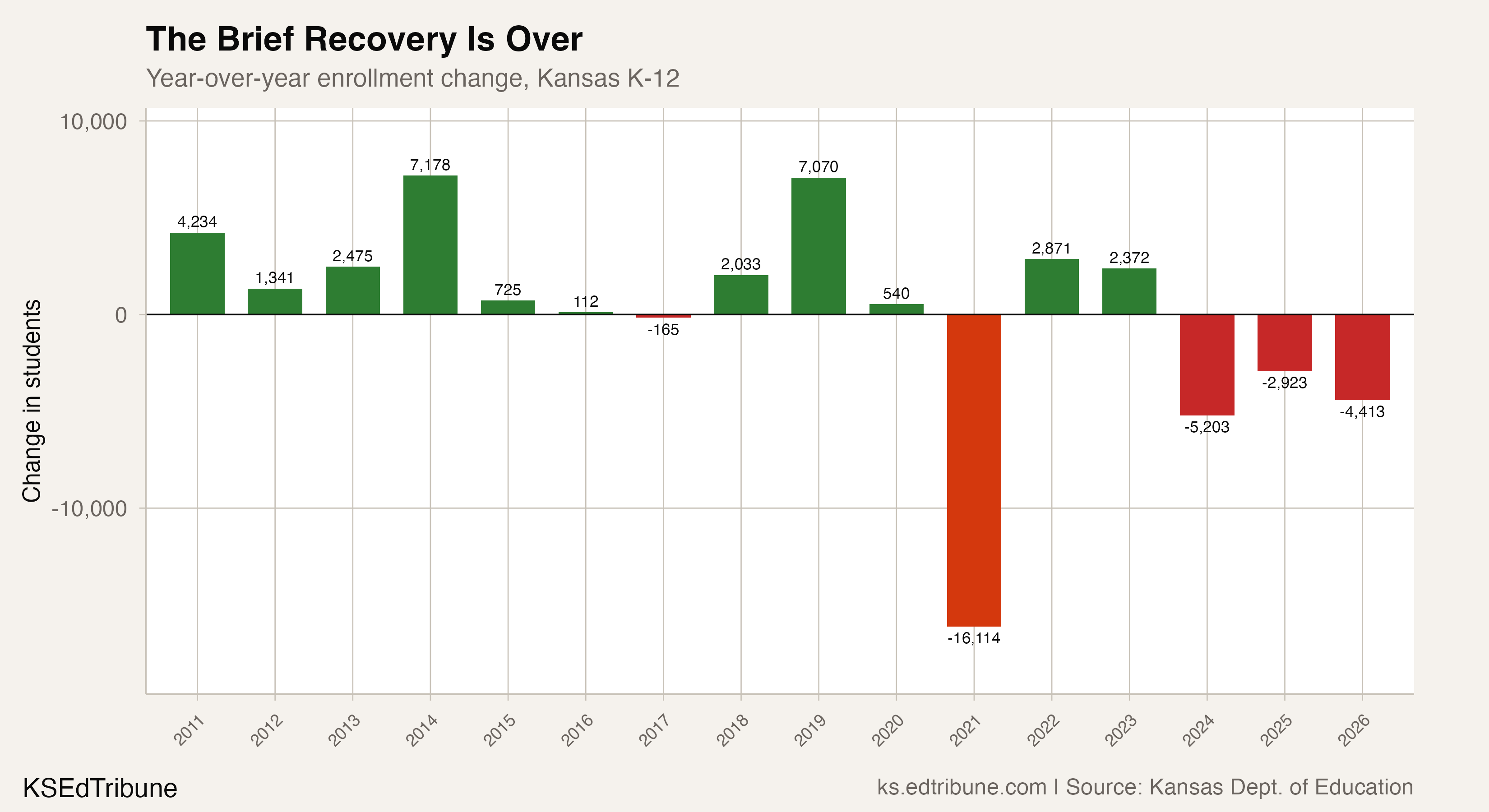
The net result: Kansas recovered 7,633 students in two years and then lost 12,734 in the next three. For every student the system clawed back, it lost 1.7 more. The state's COVID recovery rate is negative 32.3%, meaning it has added about a third again as much loss as the pandemic itself inflicted.
Mark Tallman at the Kansas Association of School Boards identified two forces behind the decline that are not going away:
"The decline is primarily due to falling birth rates and to more Kansans leaving the state than moving in, indicating further loss of enrollment is likely." -- Kansas Association of School Boards
Kansas experienced net out-migration of 26,000 people during the 2010s, and the under-five population has dropped by 30,000, or 15%, since 2014-15. Those smaller birth cohorts are now entering kindergarten, and the pipeline shrinkage has only begun to register in overall enrollment totals.
Five districts account for 40% of all losses
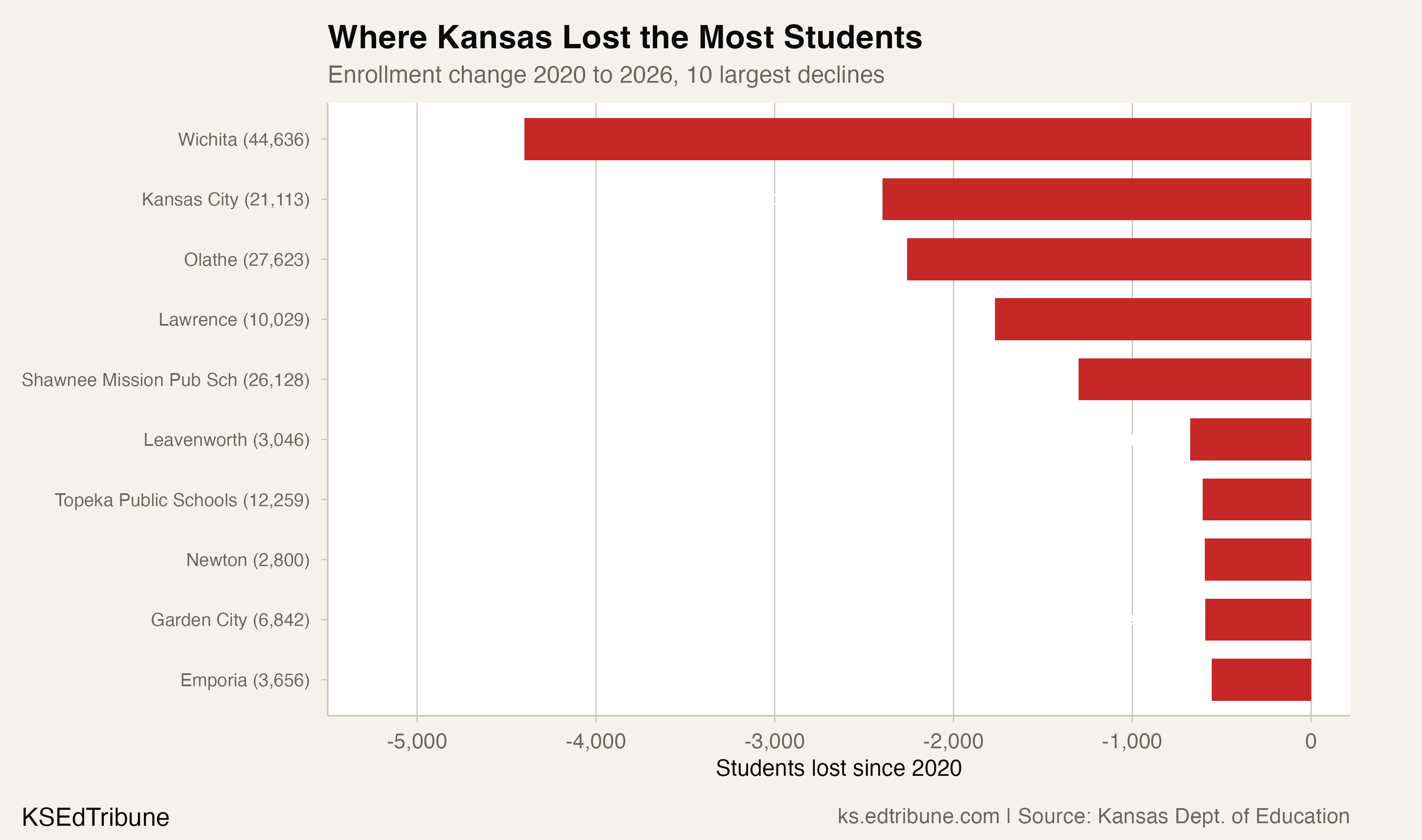
The geographic concentration of loss is severe. Wichita↗ET, the state's largest district, has shed 4,969 students since 2020, a 10.1% decline that pushed it to its all-time low of 44,406. Kansas City↗ET lost 2,341 students (-10.0%), Olathe↗ET lost 2,161 (-7.3%), Lawrence↗ET lost 1,780 (-15.0%), and Shawnee Mission↗ET lost 1,346 (-4.9%). Together, those five districts account for 12,597 of the 31,816 students shed by every declining district in the state, 39.6% of the loss concentrated in five of 285 systems.
Wichita's situation has moved from fiscal pressure to operational crisis. The district was built for 63,000 students and now serves 44,406, running at roughly 70% of that capacity. A $42 million budget gap forced the closure of multiple schools, and district leadership has signaled that more consolidation is coming.
"We have to be honest: If enrollment continues to decline... we're going to have to look at the number of schools we have to operate efficiently." -- Fabian Armendariz, Wichita Public Schools Director of Operations, KCUR, Oct. 2025
Among the 10 districts that shed the most students in absolute terms, the steepest percentage decline belongs to Emporia, down 19.3% since 2020. Leavenworth has lost 18.9%, Newton 16.7%, and Lawrence 15.0%. The erosion extends well beyond the Kansas City and Wichita metro areas.
Where students are going instead
Birth rates explain the incoming pipeline, but they do not explain students who were enrolled in 2020 and are no longer in the system. Several competing forces are pulling students out of Kansas public schools.
Homeschooling in Kansas grew 57% between 2017-18 and 2023-24, and the trend has not reversed. Johnson County suburbs saw the fastest growth: Shawnee Mission's homeschool notifications increased 162% and Blue Valley's increased 161% during that period. Accredited private school enrollment rebounded to 26,406 students statewide, further drawing from the public system.
Kansas's open enrollment law, which allows students to attend any district in the state, has also reshuffled the deck. In its first year, about 1,500 students switched districts. Wichita gained 1,557 students through open enrollment but lost approximately 2,400, a net loss of about 840 students to inter-district transfers alone.
Virtual school enrollment statewide grew from 5,658 in 2019-20 to 9,857 in 2023-24. Elk Valley, a district that enrolled 122 students in 2023-24, reports 2,384 in 2025-26, almost certainly reflecting a virtual school operation rather than an organic enrollment surge.
No single alternative accounts for the full 20,768-student deficit. The most likely explanation is that multiple exit ramps opened simultaneously: lower birth rates shrank the entering class, pandemic-era homeschooling became permanent for some families, private school enrollment recovered, and open enrollment allowed families in declining districts to leave without leaving the public system entirely.
The suburban exception is narrowing
Among the state's largest districts, only Andover↗ET (+1,692 students, +18.3%) and Spring Hill↗ET (+1,605, +36.3%) have posted substantial growth since 2020. Both are outer-ring suburbs of Wichita and Kansas City, respectively, benefiting from new subdivision development.
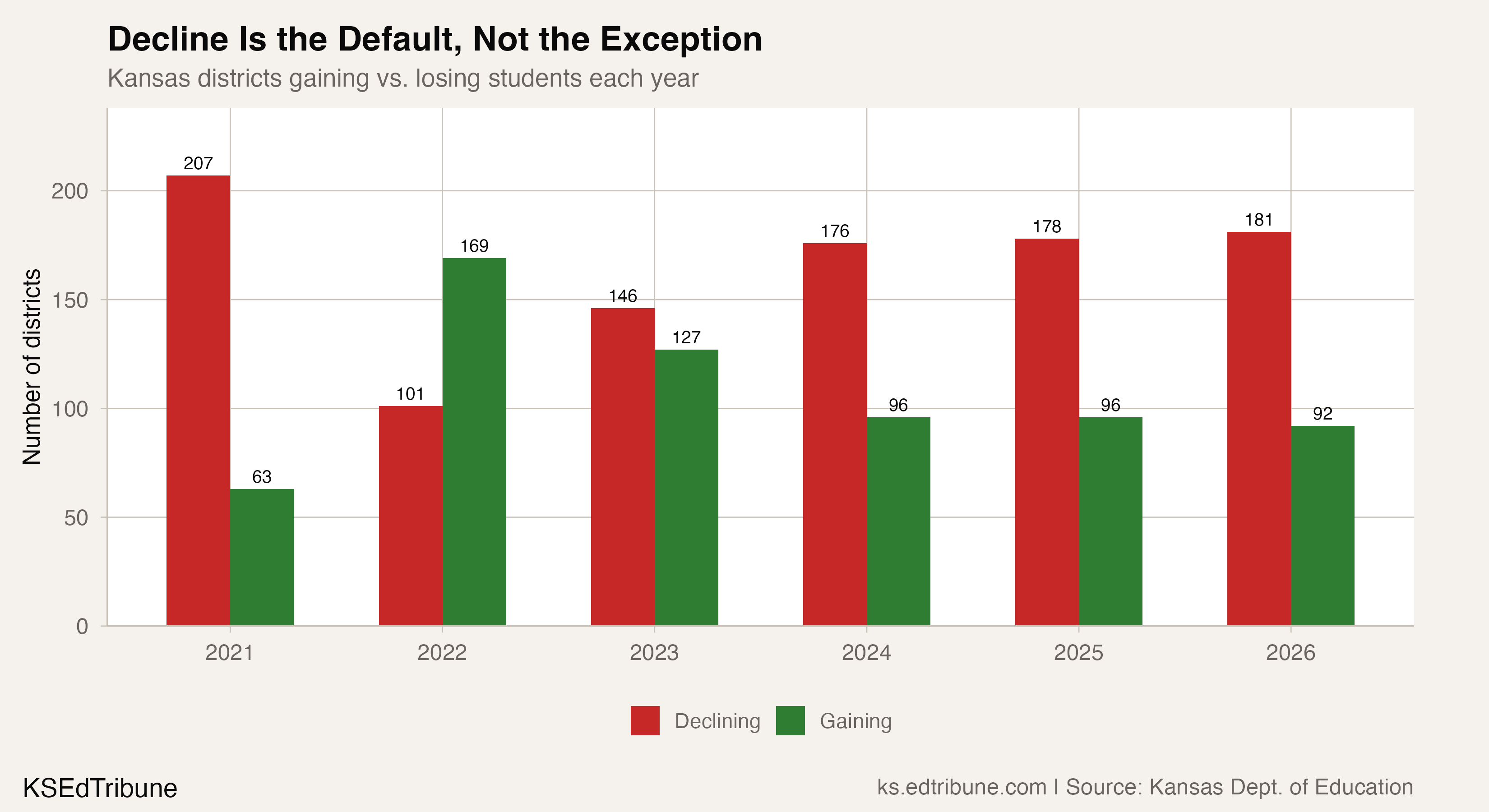
But even the suburban growth engine is running out of fuel. Maize, which grew steadily for most of the past two decades, has added 157 students since 2020, a gain of 2.0%. Topeka Public Schools↗ET lost 576 students (-4.4%). The number of districts gaining students has shrunk from 176 in 2021-22 to 74 in 2025-26, while the number declining has climbed from 105 to 205.
The distribution of damage
The recovery rate histogram tells the most complete story. A recovery rate only means something for a district that had something to recover, and 224 districts lost students in 2020-21. Of those, 79 have a recovery rate below negative 100%, meaning they have lost more additional students since the COVID trough than they lost during the pandemic itself. Another 33 sit between negative 100% and negative 50%, and 24 more between negative 50% and zero. Thirty-two districts have won back part of their pandemic loss without closing the gap, and 56 have closed it entirely or gone past it. The remaining 61 districts held flat or gained students in 2020-21, so they had no pandemic loss to make up.
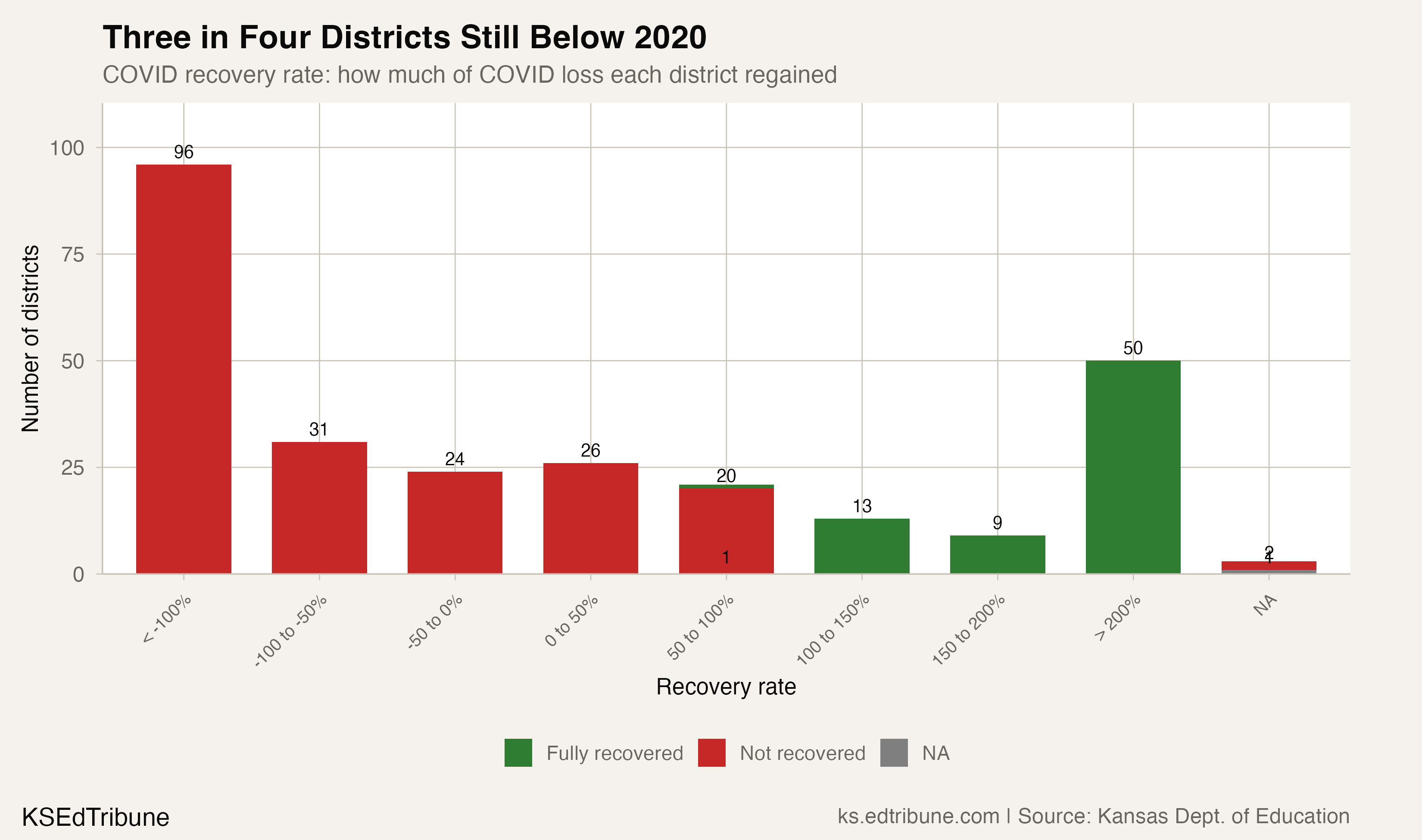
The 90 districts at their all-time low in 2025-26, versus just 10 at an all-time high, captures the asymmetry. Kansas's enrollment problem is not a pandemic hangover. The pandemic accelerated a demographic transformation that was already underway and that the state's school finance system, which allocates $5,378 per full-time student in base funding, was not designed to manage in reverse.
The cohort that has not arrived yet
The three largest single-year enrollment losses of the past decade all came after March 2020: 15,667 students in 2020-21, 5,497 in 2025-26, and 5,210 in 2023-24. The second-largest is the most recent one, and it landed five years into what was supposed to be a recovery.
The 2026-27 kindergarten class will be drawn from the cohort born during the state's lowest birth year on record. In April 2026, legislators overrode the governor's veto of SB 361, opting Kansas into the federal Education Freedom Tax Credit, while SB 75, proposing up to $8,000 per child in refundable tax credits for private school tuition, remains active.
Wichita is already closing schools. Lawrence has lost 15.0% of its students since 2020. Emporia is down 19.3%. The pandemic was supposed to be the shock. Five years later, it looks more like the starting gun.
Detailed code that reproduces the analysis and figures in this article is available exclusively to EdTribune subscribers.
Discussion
Sign in to join the discussion.
Loading comments...