Retraction, July 24, 2026. On March 30, 2026, The KSEdTribune published an article headlined "In Turner-KC, a 43-Point Demographic Reversal." It reported that two out of three Turner-Kansas City students were white in 2005 and that fewer than one in four are today, called that 43.5 percentage-point drop the largest racial composition shift in Kansas, and traced a parallel Hispanic increase from 669 students to 1,939. Not one of those figures came from a count Kansas published. We retract the article in full.
The counts we divided were never published
Kansas withholds any district enrollment count covering fewer than 10 students, because printing it could identify individual children. We built Turner's racial composition anyway, by taking district race counts out of the state's district enrollment file and dividing them by the district's enrollment total. Where the state withheld a count, that arithmetic quietly proceeded as though nothing were missing. What we divided were partial sums with a remainder we never measured.
The rule also reaches the whole row rather than only the small cell that triggers it, so a district can lose a count in the thousands. Turner's last published white-student total was 1,225 students, in 2022. There has been none since.
At Turner the defect is therefore more basic than a partial sum. The Kansas State Department of Education published no white-student total for the district in 2005, and none in 2023, 2024, 2025 or 2026. The article's headline compared two years at which the number it described does not exist. The Hispanic figure has the same hole: Turner has no published Hispanic total for 2005, so the increase we reported had no baseline to start from.
"The largest in Kansas" was never establishable
The superlative was not close to testable. Kansas had 285 school districts with a published enrollment total in 2025-26. Seventeen of them have a published white-student total in both 2005 and 2026. No ranking of racial composition change across Kansas districts can be built on 17 of 285, and Turner is not among the 17.
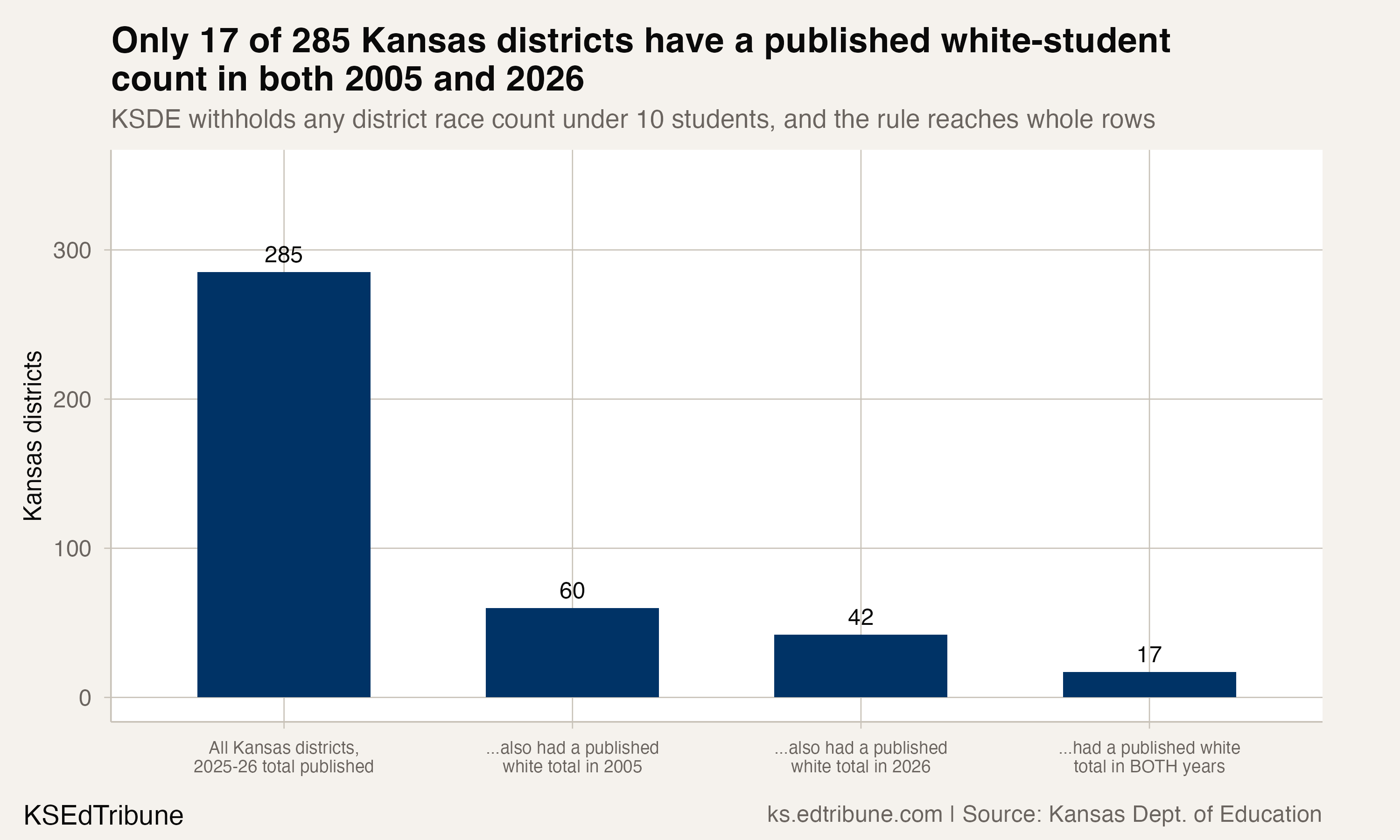
Every district the article set beside Turner fails in exactly the same way. Piper-Kansas City, Bonner Springs and Kansas City, Kansas each have no published white-student total in 2005 and none in 2026. The neighbor comparisons, the list of districts with the largest white share drops, the count of districts said to have crossed from majority-white to majority-minority, and the five charts drawn from all of it are withdrawn. Two passages in the article also repeated the statewide race series we retracted separately, and they go with the rest.
What we do not know
We do not know what share of Turner-Kansas City's students were white in 2005, and we do not know what share are white now. We are not putting an estimate, a projection or a reconstruction in place of the retracted figures, because none of those would be a measurement. The blanks in the state's file are the honest answer, and readers are entitled to see them rather than a number we manufactured around them.
Some things about Turner are published, and those survive. The district enrolled 3,885 students in 2005 and 3,875 in 2026. It enrolls 2,075 Hispanic students this year, 53.5% of the district. The share of Turner students eligible for free or reduced-price lunch rose from 49.5% to 78.4% across the same period. That is a real and consequential set of facts about a district. It is not the article we published, and we are not going to dress it up as though it were.
What we are changing
The failure is ours, not the state's. Kansas suppresses small counts to protect children and the rule worked as designed; we read past it instead of accepting what it meant for the analysis. The article also carried a fact-check, and that fact-check tested the article's numbers against the same arithmetic that produced them, which is not a test. We have rewritten the fact-check to assert this retraction, deleted the charts rather than leave them standing under a correction banner, and stripped the chart code so the withdrawn figures cannot be regenerated.
Enrollment and demographic counts for Kansas districts come from the Kansas State Department of Education's Data Central reports. Readers who relied on the original article should disregard it. We are sorry for publishing it.
Detailed code that reproduces the analysis and figures in this article is available exclusively to EdTribune subscribers.
Discussion
Sign in to join the discussion.
Loading comments...