Retraction, July 24, 2026. On April 27, 2026, The KSEdTribune published an article headlined "One in Seven Kansas Students Now Receives Special Education." It reported that 65,849 Kansas students, 14.7% of enrollment, were receiving special education services, that the number had grown 38.8% in two decades, and that the growth had accelerated after the pandemic. Those statewide figures were not supported by the data we used. We retract the article in full.
What we got wrong
Kansas does not publish the number in that headline. We produced it ourselves, by adding up district-by-district special education counts and dividing by a district-by-district enrollment total. Every statewide count, share, ratio, and trend line in the article came out of that arithmetic, and so did every chart on the page.
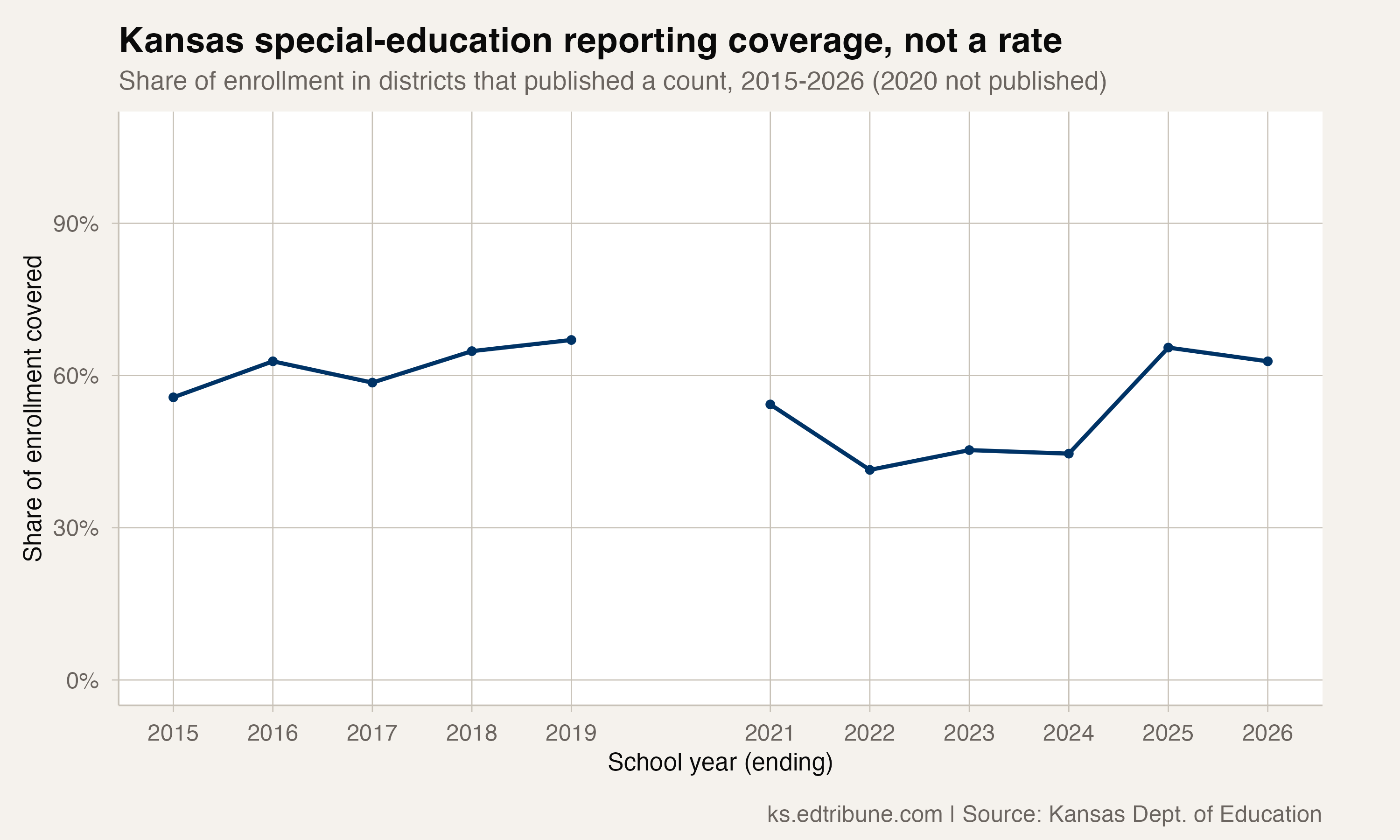
The method does not work on this source. Kansas withholds counts small enough to identify individual children, as student-privacy law requires. In the district-level enrollment file the article drew on, only 50 of the state's 285 districts published a special education count for 2025-26. Those 50 districts enroll 62.8% of Kansas students. The other 235 districts reported nothing, and our arithmetic read that silence as zero.
The trend was worse than the level. Which districts clear the privacy threshold changes from year to year, and over the two decades the article covered, the share of statewide enrollment with a published special education count swung between 27.5% and 67.0%. A rising line drawn through those sums measures how much of Kansas came into view, not how many children were receiving services. The "post-COVID acceleration" the article described is what that changing coverage looks like when you plot it.
What we do not know
We do not know how many Kansas students receive special education services, or what share of enrollment they represent, and we are not going to estimate it. No substitute figure appears in this notice, because a partial sum with a missing remainder is not a measurement and dressing it in a coverage disclaimer would not make it one.
Withdrawn along with the headline: the 22-year trend, the year-over-year growth figures, the comparison of special education growth against total enrollment, the count of districts above any threshold, the ranking of districts by rate, and the four charts. The lowest rates the article reported, in the range of 1.5% to 2.0%, were the most misleading numbers on the page. Those districts had not reported a low count. They had reported nothing, and we divided by their enrollment anyway.
What the published counts do show
Where KSDE publishes a district's special education count, that count over that district's published enrollment is a real measurement. Those rates have changed too, because the enrollment denominators were wrong in the original article, but they can be stated. In 2025-26, Topeka Public Schools↗ET reported 2,813 students receiving special education services out of 12,428 enrolled, a rate of 22.6%. Wichita↗ET reported 8,114 out of 44,406, or 18.3%.
What those numbers cannot do is rank. A district's published rate can be compared to another published rate, but neither can be placed against a state average that does not exist, and neither can be called highest or lowest in Kansas when most of Kansas is not in the file.
What happens next
Kansas does publish this information. The Kansas State Department of Education reports enrollment, including special education counts, at the state level through its Data Central portal. Those are published state values and they are the right foundation for this story. The article did not use them.
We intend to report Kansas special education enrollment properly, sourced to figures KSDE published, and to say plainly which district-level detail the privacy rules put out of reach. Until then, The KSEdTribune will not publish a statewide Kansas special education figure that does not trace to a value KSDE published.
The reporting in the original article that did not depend on the retracted series, including what educators and administrators told us about caseloads, staffing, and the gap between what the state reimburses and what services cost, still stands on its own sources. We will carry it into that later reporting rather than leave it attached to a withdrawn premise.
The failure here is ours. Kansas's suppression rules protect children and are working as intended; we read around them instead of accepting what they meant for the analysis. The article also carried a fact-check, and that check tested the article's numbers against the same partial sums that produced them, which is not a test. We are fixing how those checks are run.
Readers who relied on the original article should disregard it. We are sorry for publishing it.
Detailed code that reproduces the analysis and figures in this article is available exclusively to EdTribune subscribers.
Discussion
Sign in to join the discussion.
Loading comments...