In this series: Kansas 2025-26 Enrollment.
Correction, July 24, 2026. Every enrollment number in this article has been recalculated and every one of them changed. The original version used district totals that our data processing built by adding up grade-level rows. Kansas withholds any row covering fewer than 10 students, as student-privacy law requires, so that method dropped the withheld students and understated every district in every year, and the statewide 2025-26 count by about 23,500. The figures below now come from the headcount the Kansas State Department of Education publishes for each district. The article's finding, three straight years of decline, holds. Its size, the statewide totals, and every district figure have been corrected. We have also removed a passage and a chart on kindergarten and twelfth-grade enrollment, because KSDE withholds almost every district grade-level total and no statewide grade series can be built from this source.
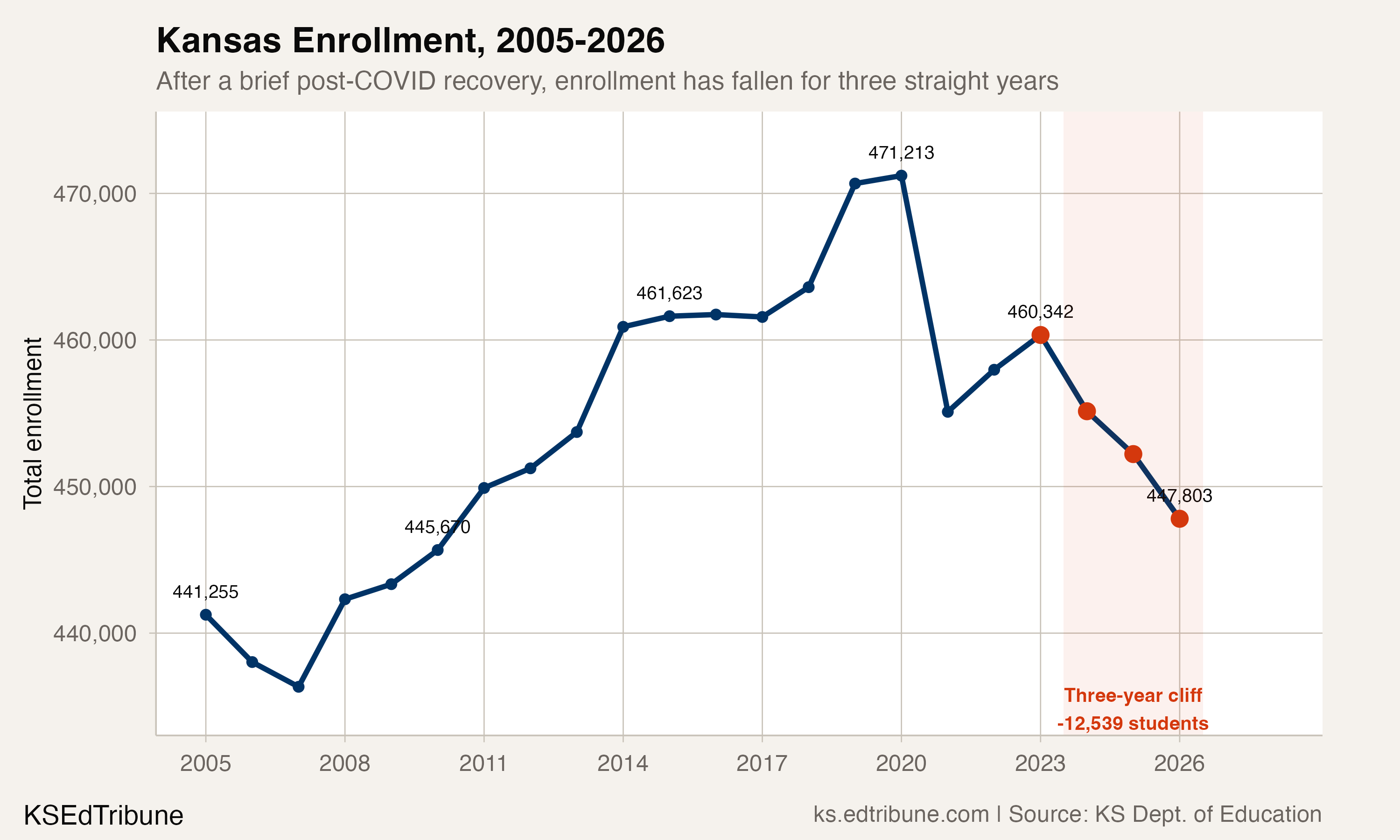
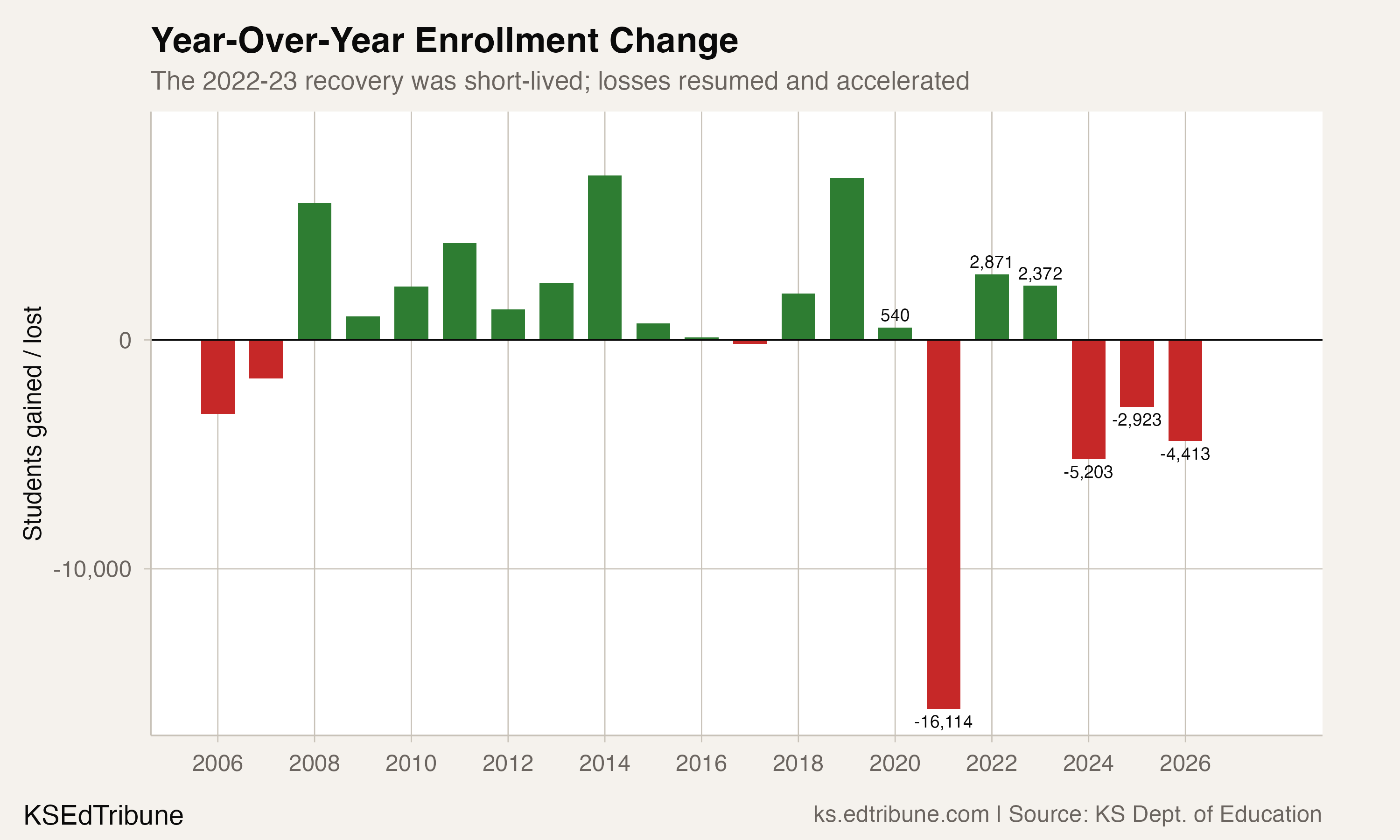
Kansas public schools gained 7,633 students across the 2021-22 and 2022-23 school years, clawing back about half of the 15,667-student crater left by the pandemic. Two years felt like a turning point. It was not.
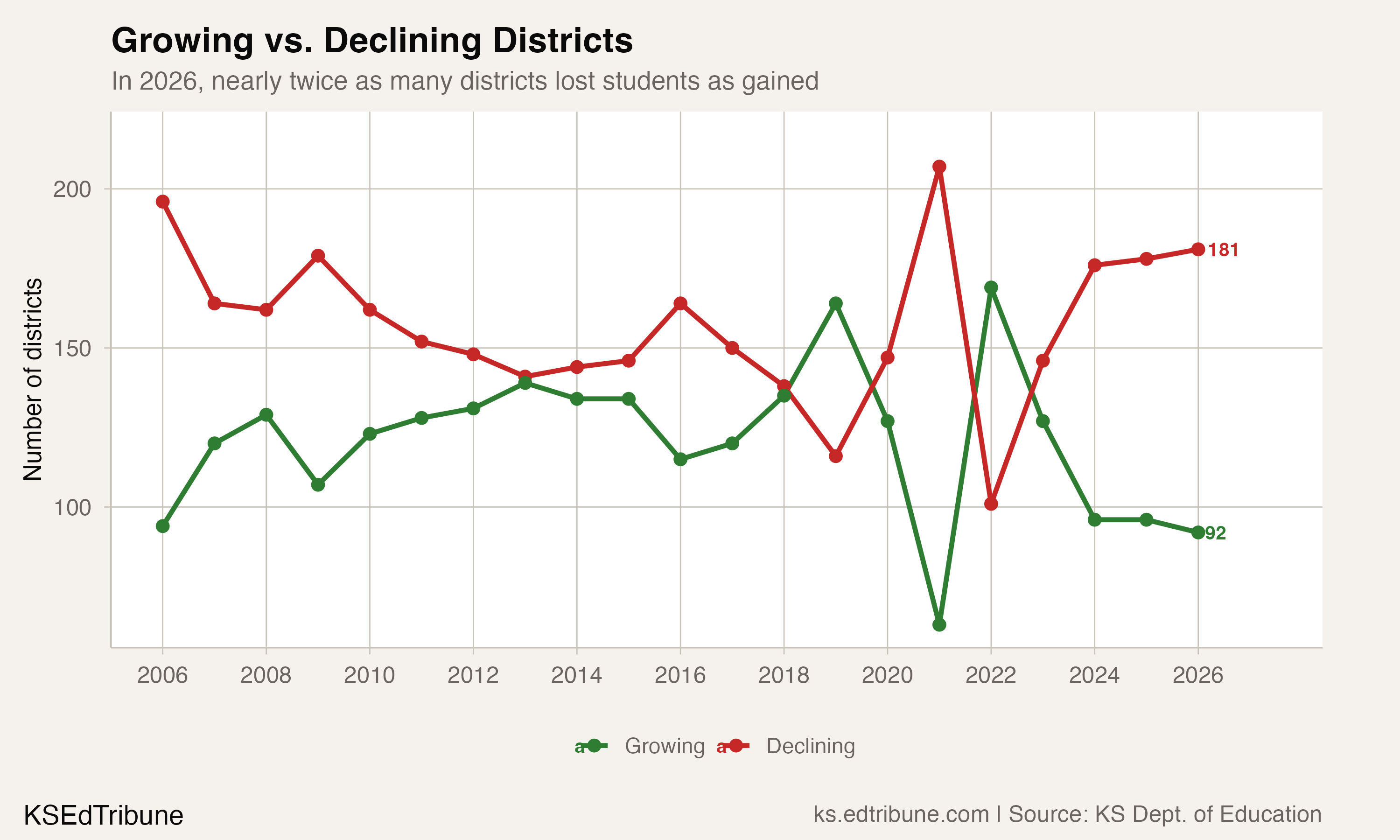
Since that brief recovery, Kansas has lost 12,734 students in three consecutive years of decline: 5,210 in 2023-24, 2,027 in 2024-25, and 5,497 in 2025-26. The state now enrolls 471,334 students, its lowest count in 18 years and 21,572 below its 2015 peak of 492,906, a 4.4% drop. In 2025-26 alone, 205 districts lost students while 74 gained. For every Kansas district that grew, nearly three shrank.
The shape of the cliff
The three-year loss is not a smooth slide. The 2023-24 drop of 5,210 was steep, followed by a comparatively mild 2024-25, then a re-acceleration in 2025-26. The combined 12,734 is the second-worst three-year stretch in the 22-year record, trailing only the 14,835 students lost between 2018 and 2021, a window that contained the pandemic year itself.
What makes this stretch different from COVID is its breadth. The pandemic produced one catastrophic year, a loss of 15,667 students in 2020-21, then two years of recovery. The current decline has ground on for three years with no reversal. And it follows a plateau rather than a boom. Across the five years from 2015 to 2020, statewide enrollment moved by 804 students, downward.
Where the students disappeared
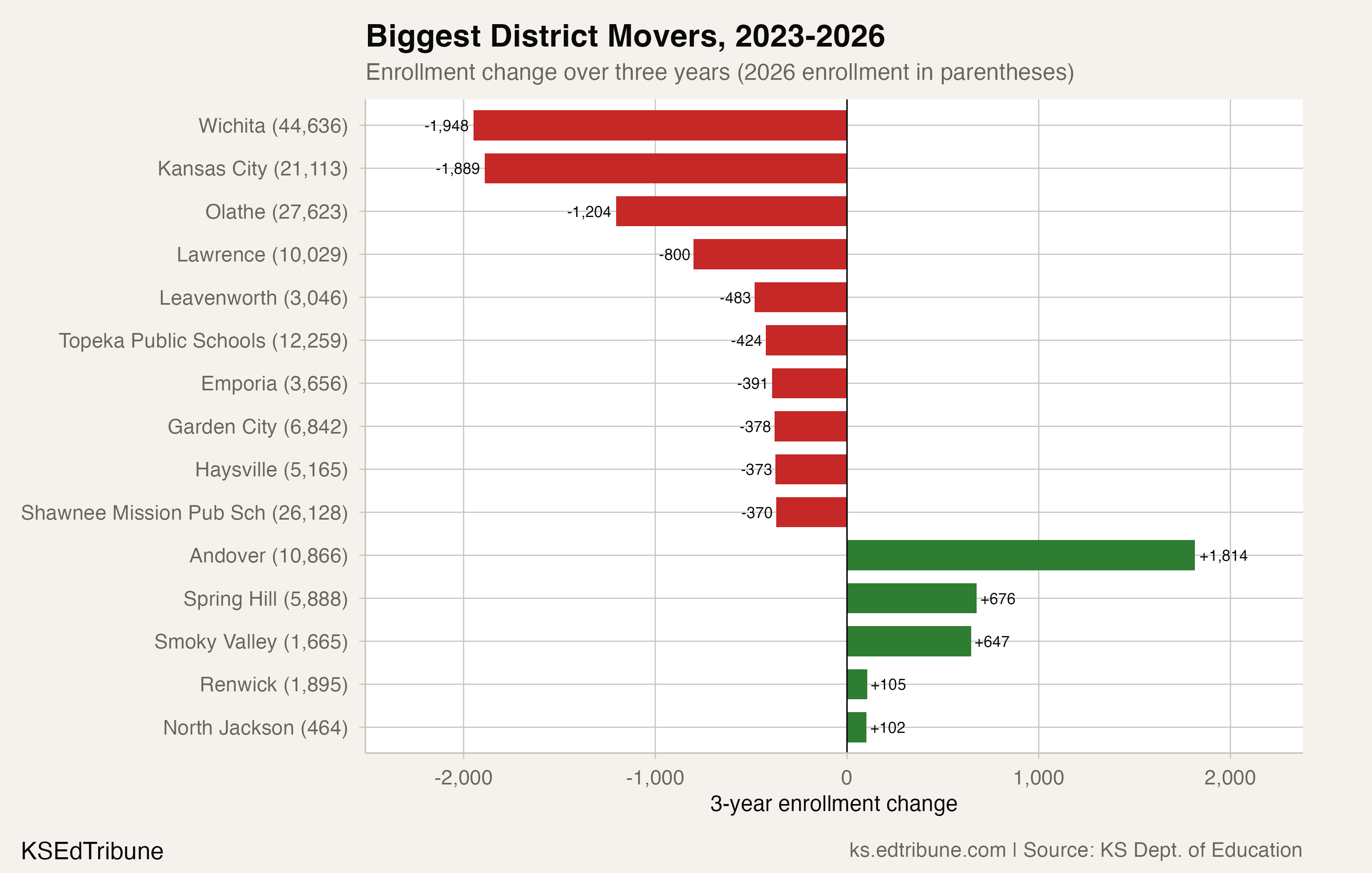
The losses concentrate in the state's largest districts. Wichita↗ET, the biggest district in Kansas, shed 2,474 students over the three years, falling to an all-time low of 44,406, a 5.3% decline. Kansas City↗ET USD 500 lost 1,844 (8.0%). Olathe↗ET, the second-largest district, dropped 1,133 (3.9%). Lawrence↗ET lost 797 (7.3%).
Those five districts account for 34.3% of every student lost by a shrinking Kansas district over the three years. But the erosion reaches well beyond the big systems. Of 285 districts, 211 lost students across the window. Leavenworth↗ET fell 14.8%. Emporia↗ET dropped 12.9%. Garden City↗ET, a meatpacking hub that had long bucked state trends through immigration-driven growth, slid 3.3%.
The districts that grew tell their own stories. Andover↗ET added 1,872 students (20.6%), though it has a history of boundary changes and its 2026 jump of 1,356 in a single year may reflect a structural shift rather than organic growth. Spring Hill↗ET gained 724 (13.6%), continuing its run as a fast-growing Kansas City suburb. The largest gain in the state belongs to Elk Valley, which had fewer than 130 students in every year from 2016 through 2024 and reported 2,384 in 2025-26. A change of that shape is a program or a boundary decision, not local growth, and the enrollment file does not say which.
Fewer babies, more exits
The most straightforward explanation for the decline is demographic. Kansas's birth rate in 2023 fell to 11.6 per 1,000, the lowest since records began in 1912. The number of Kansas children under five has dropped more than 15% since 2014-15, according to the same analysis by the Kansas Association of School Boards. Smaller birth cohorts that entered kindergarten five and six years ago are moving through the system now, with no larger cohorts behind them to fill the gap.
What that pipeline looks like grade by grade is not something the state's district enrollment file can show. KSDE withholds any row covering fewer than 10 students, and in 2025-26 only 11 of 285 districts published a kindergarten total that cleared the threshold. An earlier version of this article reported statewide kindergarten and twelfth-grade counts assembled from the districts that did report. Those counts were wrong and have been removed.
Competition from non-public education is a contributing factor, though its scale is harder to pin down. Full-time virtual school enrollment in Kansas rose from 5,658 in 2019-20 to 9,857 in 2023-24. The state's Tax Credit Scholarship program for private schools grew from 109 scholarships in 2016 to 2,360 in 2024-25. Kansas legislators have introduced a $125 million voucher proposal (SB 75) that would offer up to $8,000 per child for private school tuition. If enacted, it could accelerate departures from public enrollment.
But those programs remain small relative to the decline. The 2,360 tax credit scholarships and roughly 4,200 additional virtual FTE since 2020 together account for a fraction of the 20,768 students Kansas has lost since 2019-20. Birth rates and out-migration remain the primary drivers.
The fiscal arithmetic
Kansas funds schools through a per-pupil formula. The base amount for 2025-26 is $5,615 per student, with additional weightings for students identified as at risk, students learning English, students receiving special education services, and transportation. When enrollment drops, funding follows. The 12,734 students lost since 2023 represent roughly $71 million in base funding alone, before weightings.
Total per-pupil spending has reached $18,858, a record. But that figure partly reflects the denominator shrinking: fewer students dividing a budget that has not contracted as fast as enrollment. Districts collectively held $3.1 billion in cash reserves as of July 2025, including $1.33 billion for operations. Those reserves mask the structural problem. Fixed costs for buildings, transportation routes, and administrative overhead do not shrink proportionally when a district loses 50 or 100 students.
"The decline is primarily due to falling birth rates and to more Kansans leaving the state than moving in, indicating further loss of enrollment is likely." -- Kansas Association of School Boards, September 2025
A widening gap between growers and shrinkers
The ratio of declining to growing districts has shifted decisively. In 2022, the post-COVID rebound briefly pushed more districts into the gain column than the loss column, 176 growing against 105 declining. By 2026 the ratio had flipped and then some: 205 districts declining, 74 growing.
Ninety districts, 31.6% of the total, hit their all-time enrollment low in 2025-26. Ten hit all-time highs. Among those at rock bottom: Wichita↗ET (44,406), Topeka Public Schools↗ET (12,428), Lawrence↗ET (10,099), Leavenworth↗ET (3,075), and Emporia↗ET (3,785). The list spans the state's urban cores, its college towns, and its military-adjacent districts.
Ninety of the 285 districts have climbed back to their 2019-20 enrollment. The other 195 have not. Kansas is not bouncing back from COVID. It is settling into a lower baseline that continues to erode.
What to watch next
The 2026 re-acceleration, after a milder 2025 that briefly looked like a floor, suggests Kansas has not found stable ground. Federal funding cuts of $5 million to Kansas City USD 500, $1 million each to Olathe and Shawnee Mission pile onto the enrollment-driven revenue slide. The 2025-26 SB 75 voucher proposal died, though future school-choice proposals could reappear.
In Wichita, where the board has already voted to close buildings, the planning horizon has shifted from "if" to "which ones next." Ninety districts across the state sit at their lowest enrollment on record. Kansas has lost students in four of the past six years. The two gain years returned 7,633 students. The three loss years since have taken 12,734.
Detailed code that reproduces the analysis and figures in this article is available exclusively to EdTribune subscribers.
Discussion
Sign in to join the discussion.
Loading comments...