In this series: Kansas 2025-26 Enrollment.
Correction, July 24, 2026: When this article was first published on April 6, 2026, it said Goddard held the longest enrollment growth streak in Kansas. That was wrong. Piper-Kansas City grew for 20 consecutive school years, two more than Goddard, and the headline, the opening and the rankings chart were all built on the error. The article has been rewritten around the corrected ranking. Two sections were removed rather than fixed, because the Kansas State Department of Education publishes nothing to support them: a section on Goddard's kindergarten pipeline, and most of a section on the district's changing demographics. The enrollment figures throughout have also been corrected.
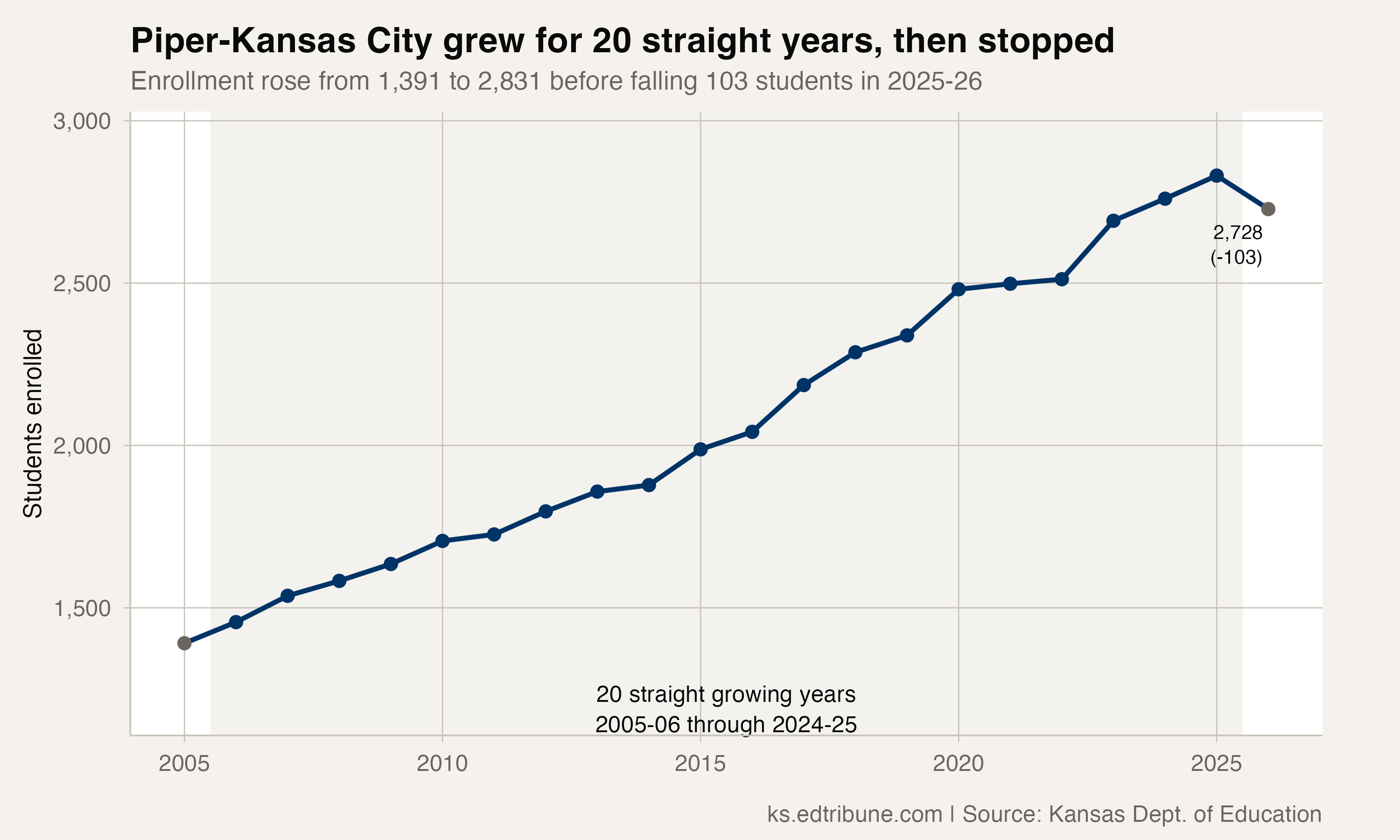
For 20 consecutive school years, Piper-Kansas City↗ET grew. From 2005-06 through 2024-25 the district on the western edge of Wyandotte County added students every single year, going from 1,391 to 2,831. That is 1,440 more children in its buildings, and it means Piper more than doubled while most of Kansas was shrinking. No other district in the state has put together a run that long.
Then it stopped. Piper enrolled 2,728 students in 2025-26, down 103 from the year before.
Twenty years without a down year
What is striking about Piper's run is how unspectacular each individual year was. The smallest gain of the streak was 14 students. The largest was 180. There was no single boom year that carried the rest; the district simply never had a year that went backward, for two decades.
Piper's own explanation is construction. The district passed a $64 million bond in 2022, citing its standing as one of the fastest-growing districts in Kansas and a student body speaking more than 27 languages. That is a lot of new capacity to have financed on the assumption that the line keeps going up.
Goddard's 18 years, and how they ended
The second-longest run belongs to Goddard↗ET, the district immediately west of Wichita. It grew in 18 straight school years, 2005-06 through 2022-23, climbing from 4,259 students to 6,316. In raw headcount that is the larger achievement: 2,057 students added, a 48.3% increase, against Piper's 1,440.
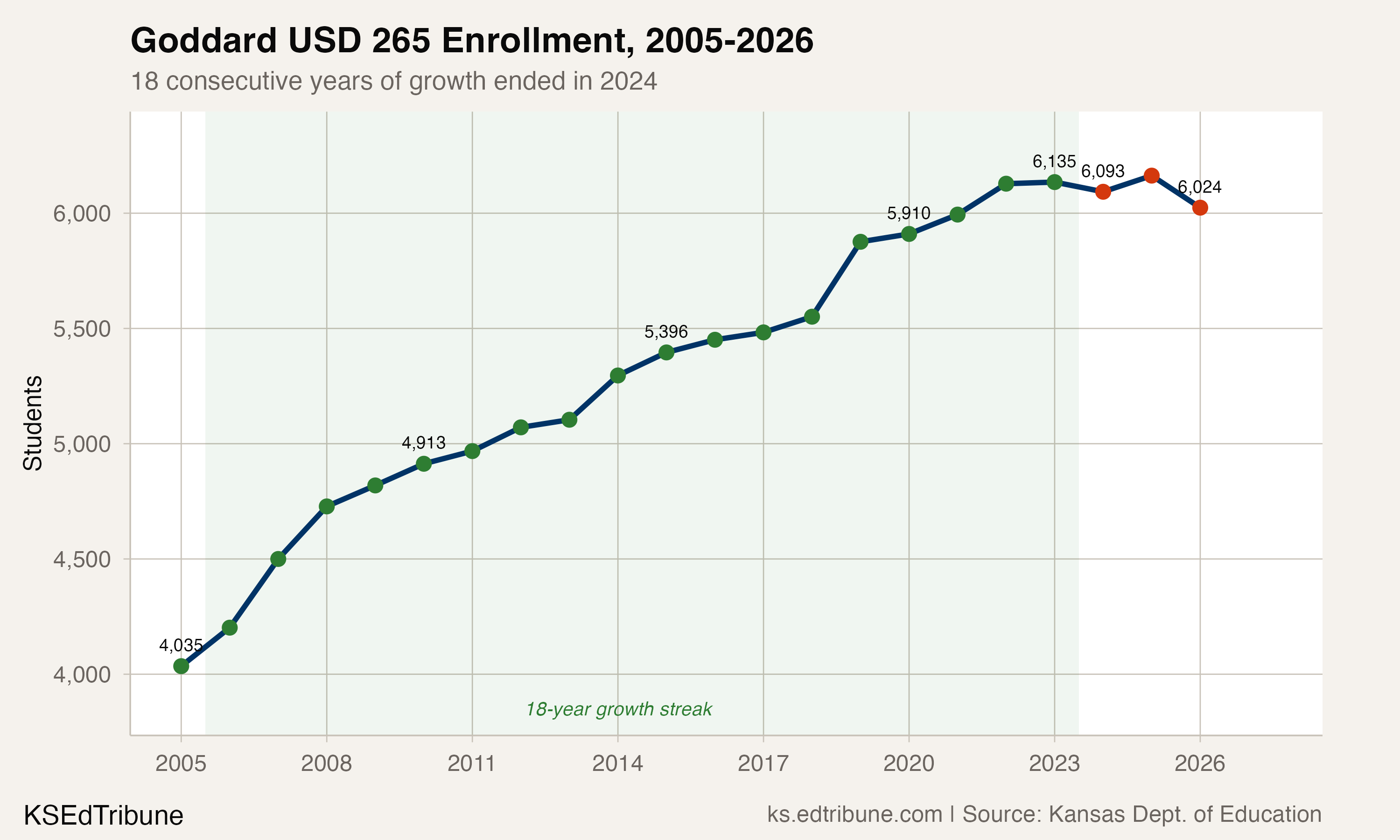
The end of the streak was quieter than its middle. Goddard added 10 students in its final growing year. That was not the thinnest year of the run, either: it had added just six in 2016-17 and kept going. Then the direction changed. The district lost 57 students in 2023-24, gained 53 back in 2024-25, and lost 131 in 2025-26, finishing at 6,181.
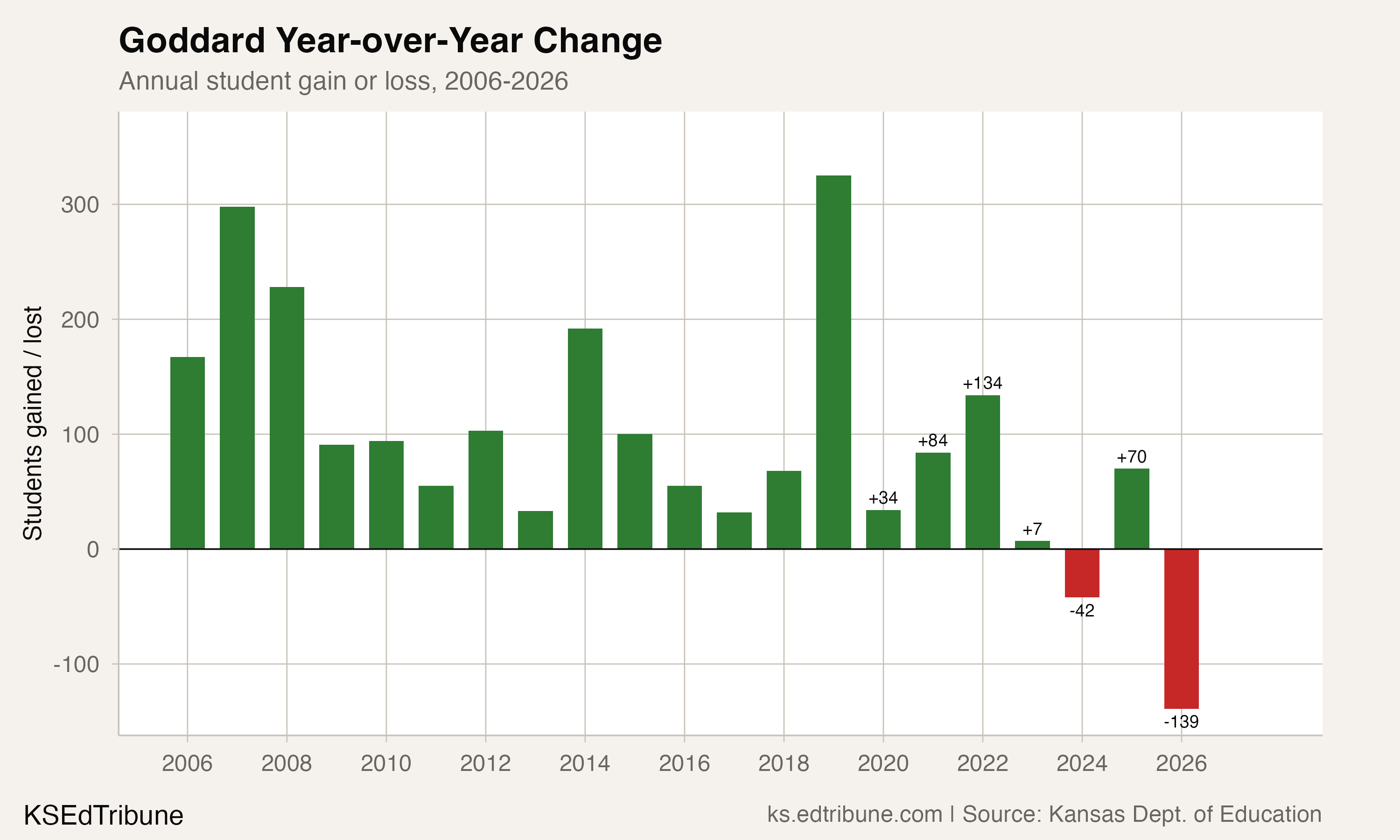
Measured across the whole 21 years of change in the published record, Goddard grew 45.1%. Among the 30 Kansas districts that already enrolled at least 3,000 students in 2004-05, that ranks fourth, behind Andover, Gardner Edgerton and De Soto.
A $196 million plan that voters rejected
Goddard's board saw the growth continuing. In December 2024 it unanimously approved a $196 million bond proposal to build two new elementary schools, convert Oak Street Elementary into a pre-K learning center, and upgrade facilities across the district.
"Just like in the early 2000s, the Goddard community itself was one of the fastest growing cities in Kansas. We are experiencing that growth again." -- Dane Baxa, Goddard Education Foundation, KWCH, April 2025
On May 13, 2025, voters rejected the bond by roughly 500 votes: 2,541 against, 2,053 in favor. The measure would have raised property taxes by about $10 per month per $100,000 of assessed home value. In a district where 1,984 students, or 32.1% of enrollment, qualify for free or reduced-price lunch, that monthly figure was not abstract.
The vote leaves Goddard planning around thousands of platted residential units with no new school buildings authorized.
The rest of the leaderboard
Only two Kansas districts reached 18 straight growing years at all. After Piper and Goddard, Olathe↗ET and Maize↗ET each managed 15, and both runs ended the same way: their last growing year was 2019-20, and the pandemic enrollment drop broke them. Hoxie Community Schools, Gardner Edgerton↗ET and Auburn-Washburn↗ET each reached 13.
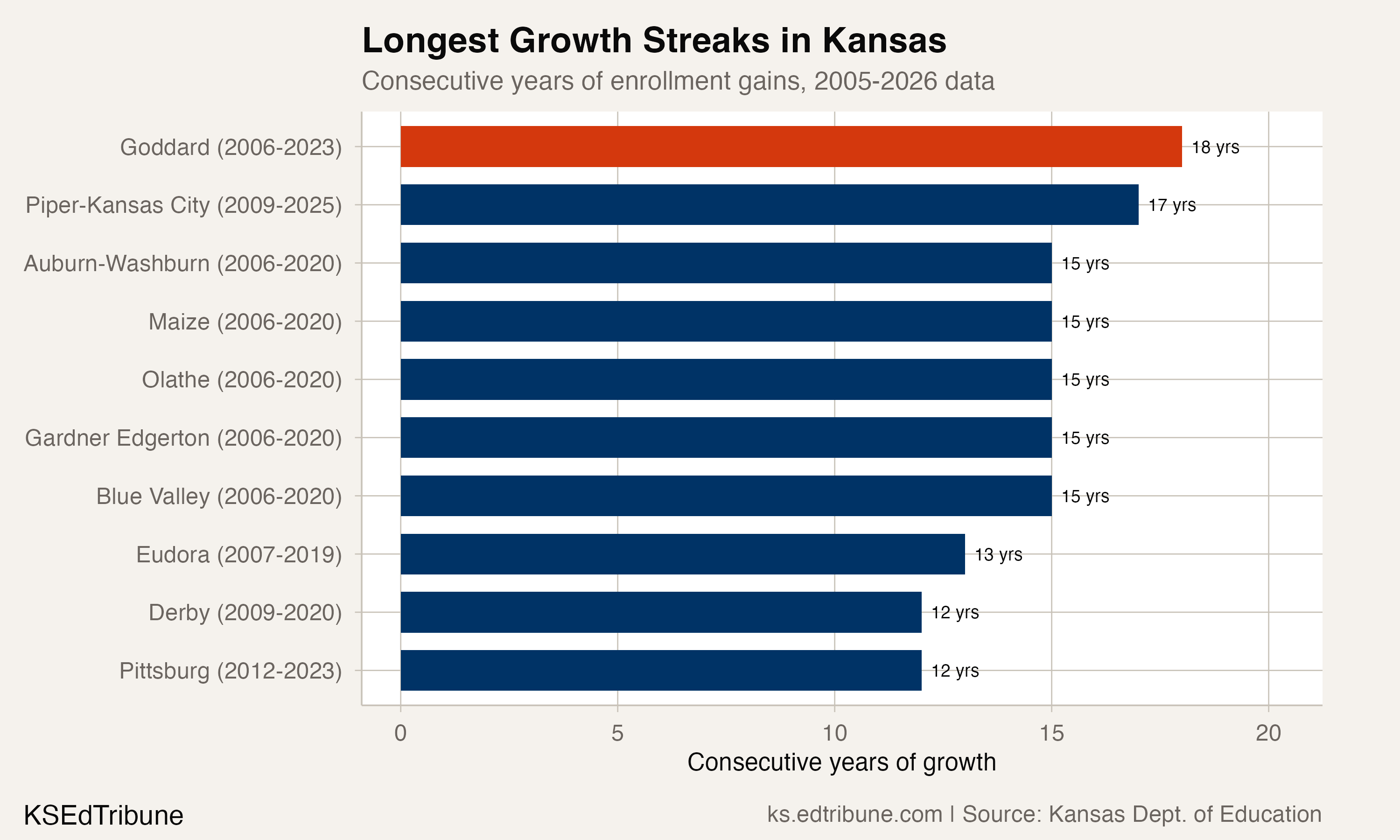
Every district on that leaderboard lost students in 2025-26. Olathe lost the most, 305. The record holders and the near-misses are all now moving in the same direction as the rest of the state: 205 of Kansas's 285 districts enrolled fewer students in 2025-26 than the year before.
Where the Wichita suburbs actually stand
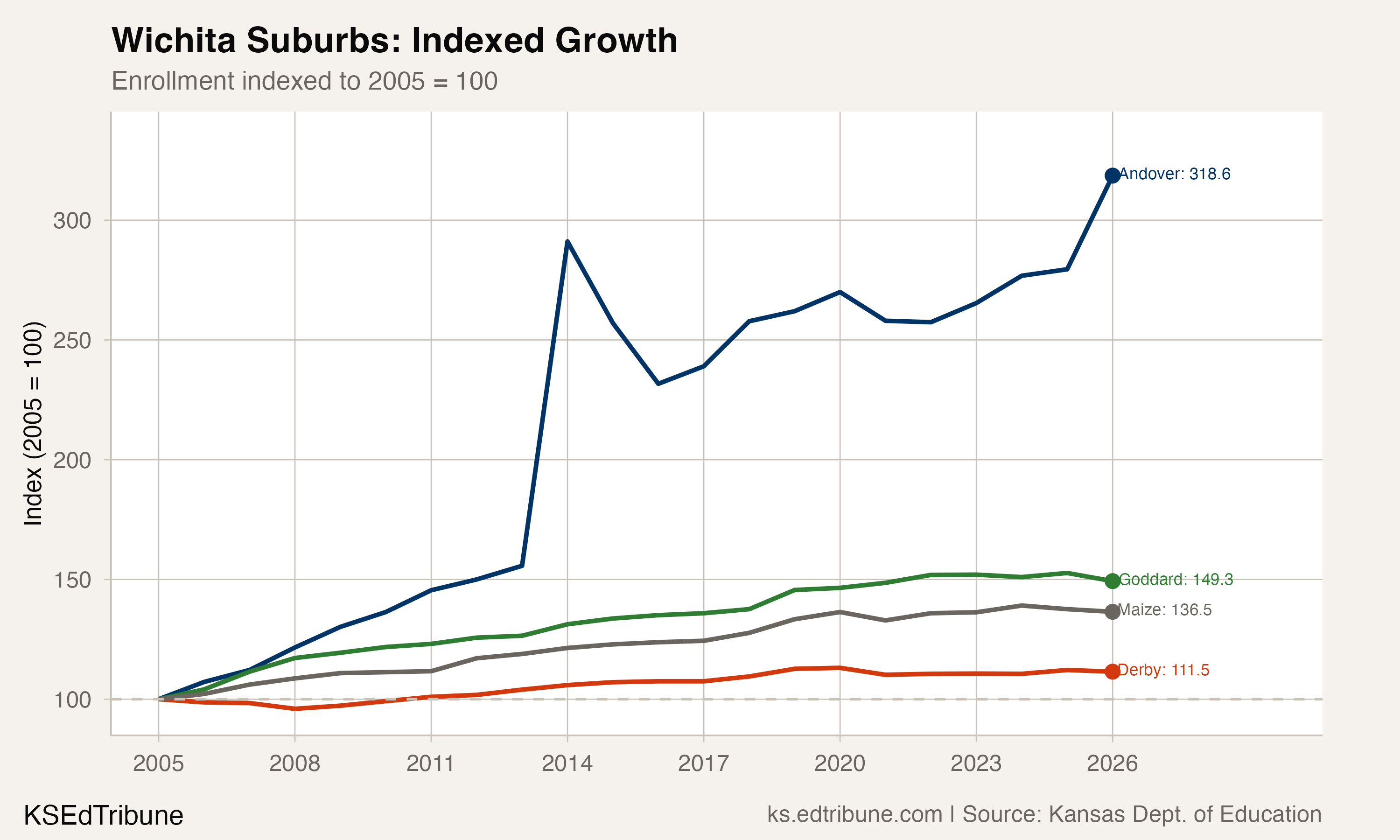
Andover↗ET is the exception that needs an asterisk. It enrolled 3,796 students in 2004-05 and 10,942 in 2025-26, which works out to 188.3%. But its series contains a break: the district gained 4,583 students in 2013-14 and then lost students in each of the two years that followed. That is not what a year of growth looks like, and the 21-year percentage should not be read as one. Maize grew 31.9% over the same window and Derby↗ET 9.7%.
Wichita↗ET enrolls 44,406 students, its lowest figure in the 22 years of published district data. The four suburbs around it now enroll 32,284 between them, up from 20,673, and their share of the metro's enrollment has gone from 29.8% to 42.1%. Andover was the only one of the four to gain last year, and it gained a lot: 1,356 students.
The rooftops and the birth rate
Housing has been the engine on both ends of the state. A 2024 study cited by Goddard identified 53 active housing developments inside district boundaries with more than 5,900 residential units planned. Piper's bond rested on a similar picture in Wyandotte County.
Working against it is a supply problem no subdivision can fix. Kansas births fell to 11.6 per 1,000 residents in 2023, the lowest rate since the state began keeping records in 1912, and the state's population under 18 has fallen by more than 36,000 since 2015. Families are also choosing differently: a 2024 KCUR analysis found that thousands of Kansas families who tried homeschooling during the pandemic stayed with it, and the state's virtual programs pull students without anyone moving.
What a broken streak actually costs
A growth streak is not a trophy. It is a planning assumption, and districts borrow against it. Piper carries a bond passed on the expectation of more students and just recorded its first enrollment loss in 20 years. Goddard asked its voters for $196 million on the same expectation, was told no, and has now lost students in two of the last three years.
The two districts that grew the longest in Kansas both ended their runs inside the same three-year window, and every district that came close to them shrank last year. Whatever comes next in Piper and Goddard, it will have to be planned on a different assumption than the one that built them.
Detailed code that reproduces the analysis and figures in this article is available exclusively to EdTribune subscribers.
Discussion
Sign in to join the discussion.
Loading comments...