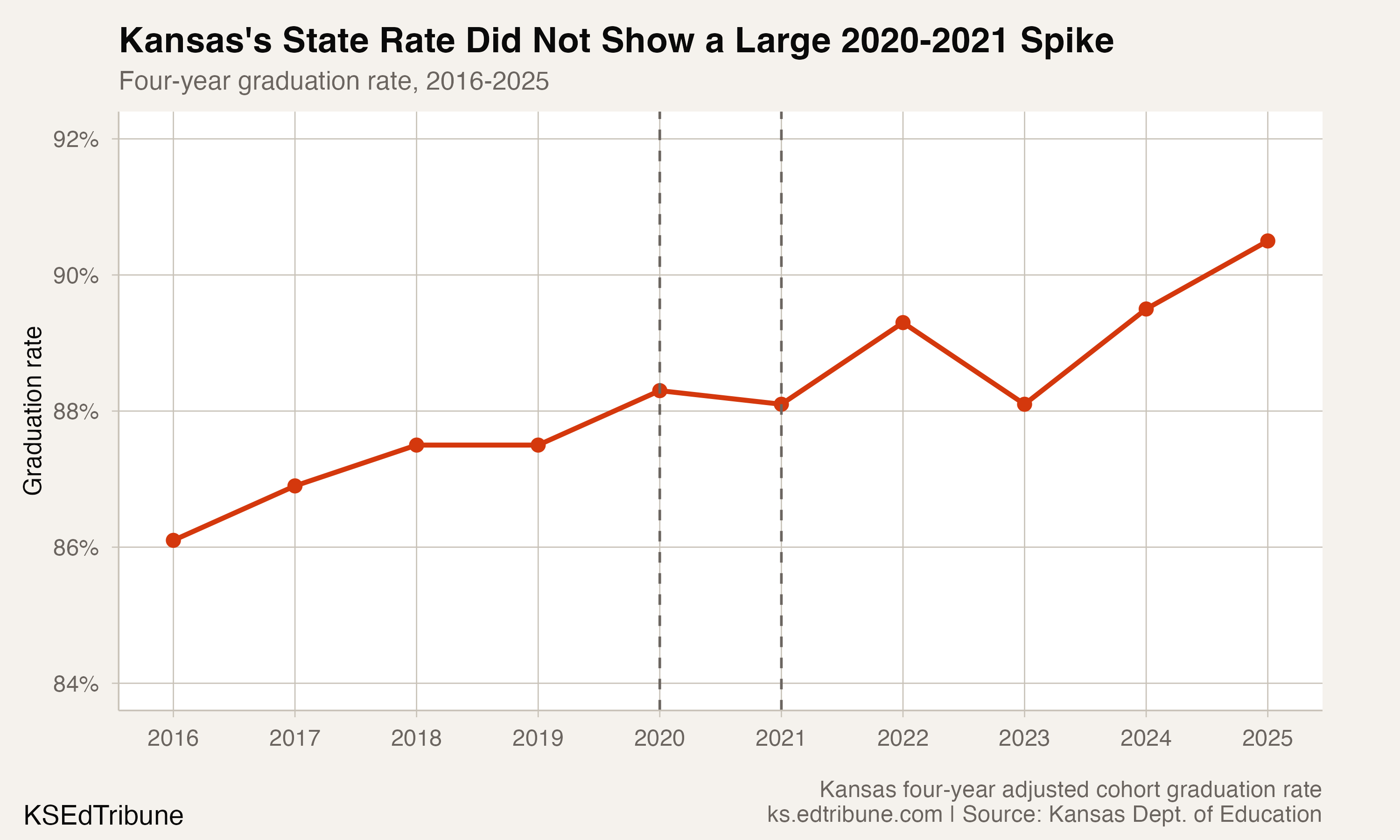
Kansas's statewide four-year graduation rate rose from 87.5% in 2019 to 88.3% in 2020, then slipped to 88.1% in 2021. The changes were a gain of 0.8 point followed by a decline of 0.2 point.
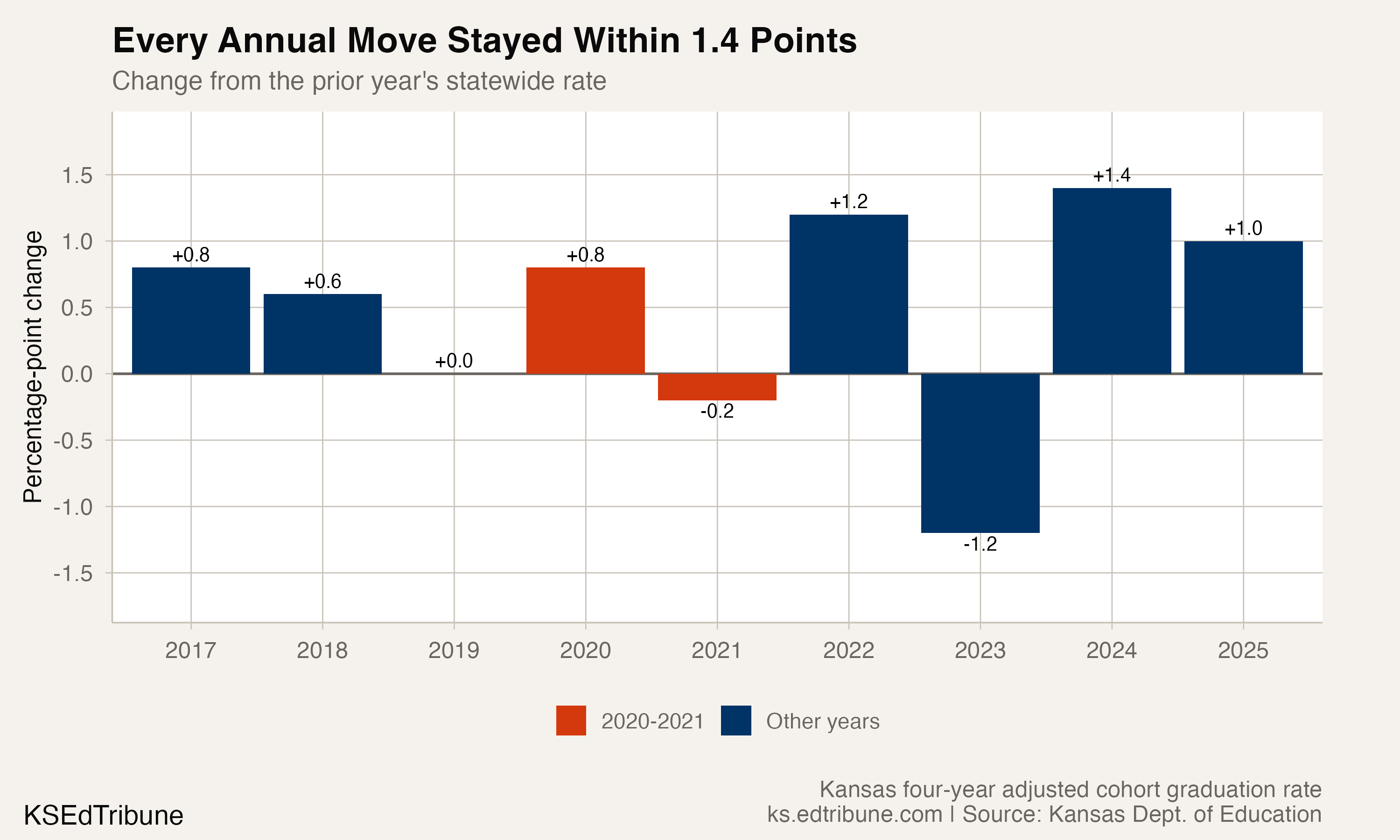
Neither transition was the largest annual move in the 2016-2025 panel. The biggest absolute change was 1.4 points, an increase in 2024.
The categorical discovery claim was too strong
The discovery hook said Kansas never received a pandemic-era graduation bump. The rate did increase in 2020, so the data do not support that literal statement.
What the series shows is narrower: the 2020 increase was moderate within the panel, and the following year's decline was small. Across the two transitions from 2019 through 2021, the rate finished 0.6 point higher.
That pattern lacks a large one-year spike followed by an equally large correction. It does not prove the pandemic had no effect. The file has no counterfactual Kansas, no coded policy measures and no student-level histories.
Later years were more volatile
The state rate rose 1.2 points in 2022, fell 1.2 points in 2023 and rose 1.4 points in 2024. It added another 1.0 point in 2025, reaching 90.5%.
Across all nine annual transitions, Kansas recorded six increases, one flat result and two decreases. Every annual move stayed within 1.4 points in either direction.
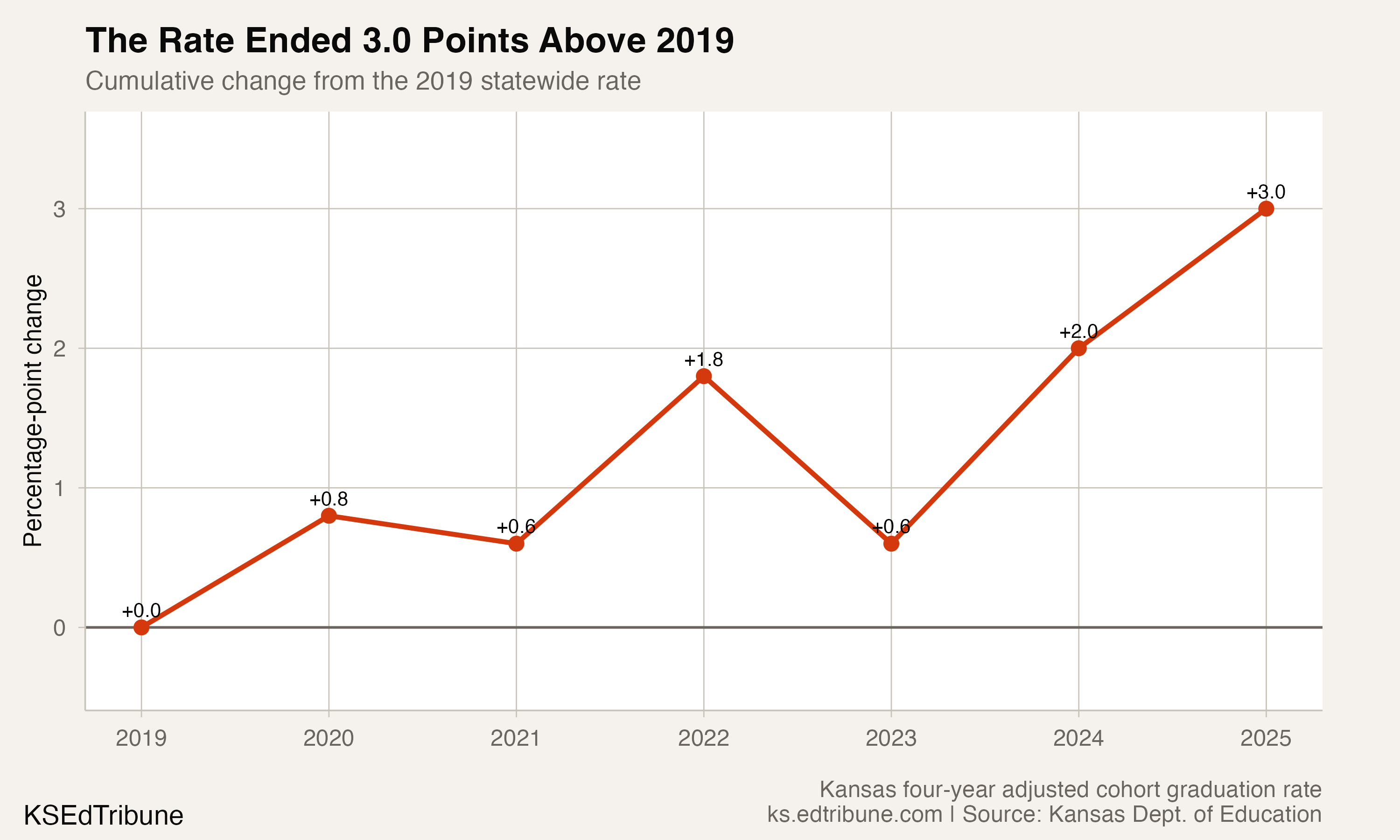
The rate also remained above its 87.5% 2019 level in every observation from 2020 through 2025. It ended at 90.5%, 3.0 points above 2019 and 2.2 points above 2020.
A descriptive result, not a mechanism
The statewide aggregate cannot separate changes in grading, attendance, transfers, course completion, cohort composition or student support. Any of those could be a competing explanation for a particular annual movement, and none is measured here.
The package also lacks usable cohort and graduate counts, so the rate changes cannot be translated into student totals. Nor can a stable statewide line rule out larger changes within particular districts or student groups.
The evidence supports a disciplined conclusion: Kansas did not show an unusually large 2020 increase or a matching 2021 reversal in this state series. It does not support a claim that the pandemic had no influence on graduation.
Detailed code that reproduces the analysis and figures in this article is available exclusively to EdTribune subscribers.
Discussion
Sign in to join the discussion.
Loading comments...