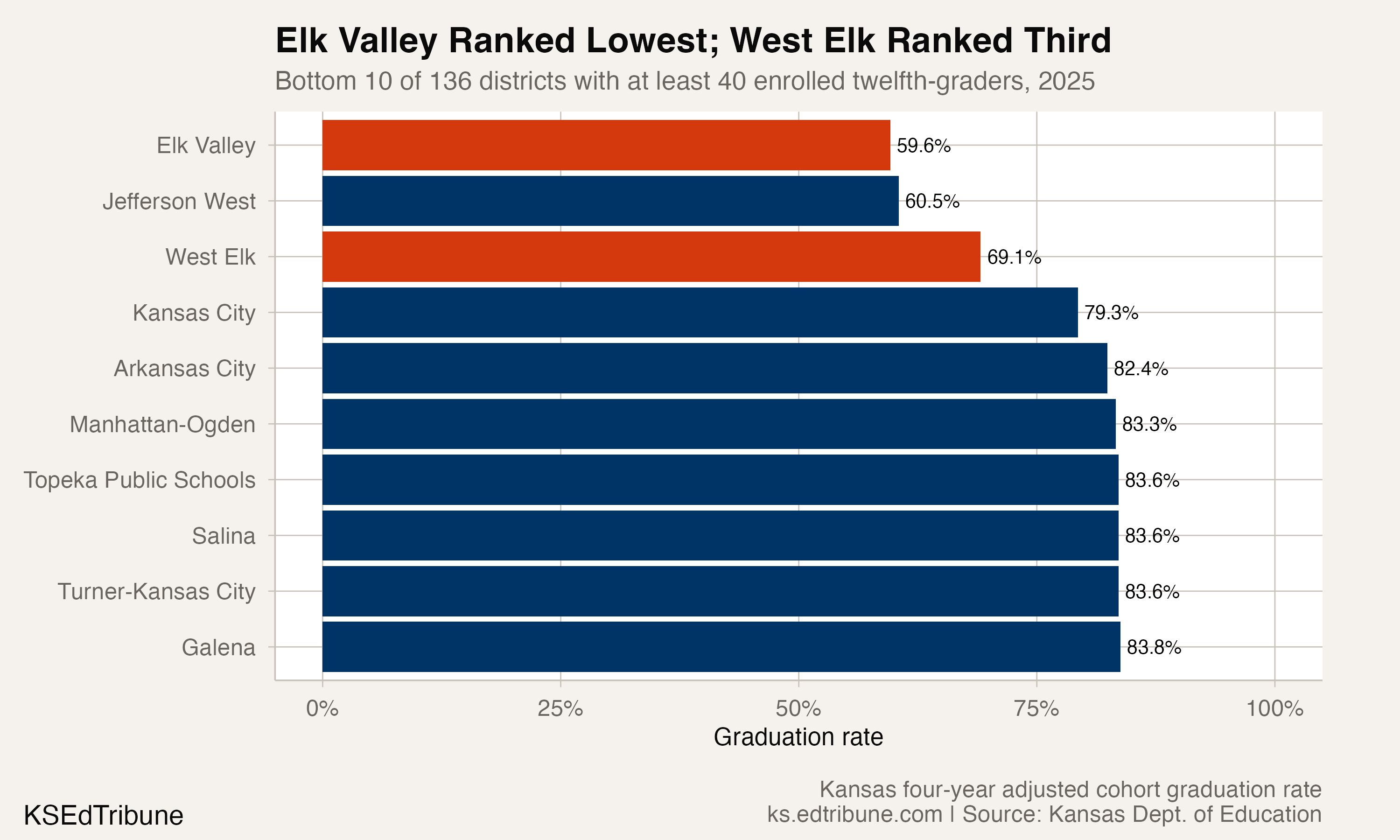
Elk Valley↗ET USD 283 posted a 59.6% four-year graduation rate in 2025. That was the lowest result among 136 Kansas districts with at least 40 enrolled twelfth-graders.
West Elk↗ET USD 282 posted 69.1%, ranking third. Jefferson West sat between them at 60.5%, correcting the discovery's initial description of the two hosts as the bottom two.
These district labels need context
The package identifies Rocket Online Schools within Elk Valley and West Elk Virtual Academy within West Elk. Rocket Online Schools describes its Kansas program as statewide online education delivered through a partnership with Elk Valley USD 283. KSDE's current virtual-school monitoring plan lists West Elk USD 282 among virtual programs.
That means neither headline rate should be read simply as the outcome of students living near Longton or Howard. The district rows include systems that enroll online students beyond the immediate geography.
The identification also corrects an outdated name in the discovery document. Elk Valley's 2025 school row is Rocket Online Schools, not Insight School of Kansas.
School rows show why aggregation matters
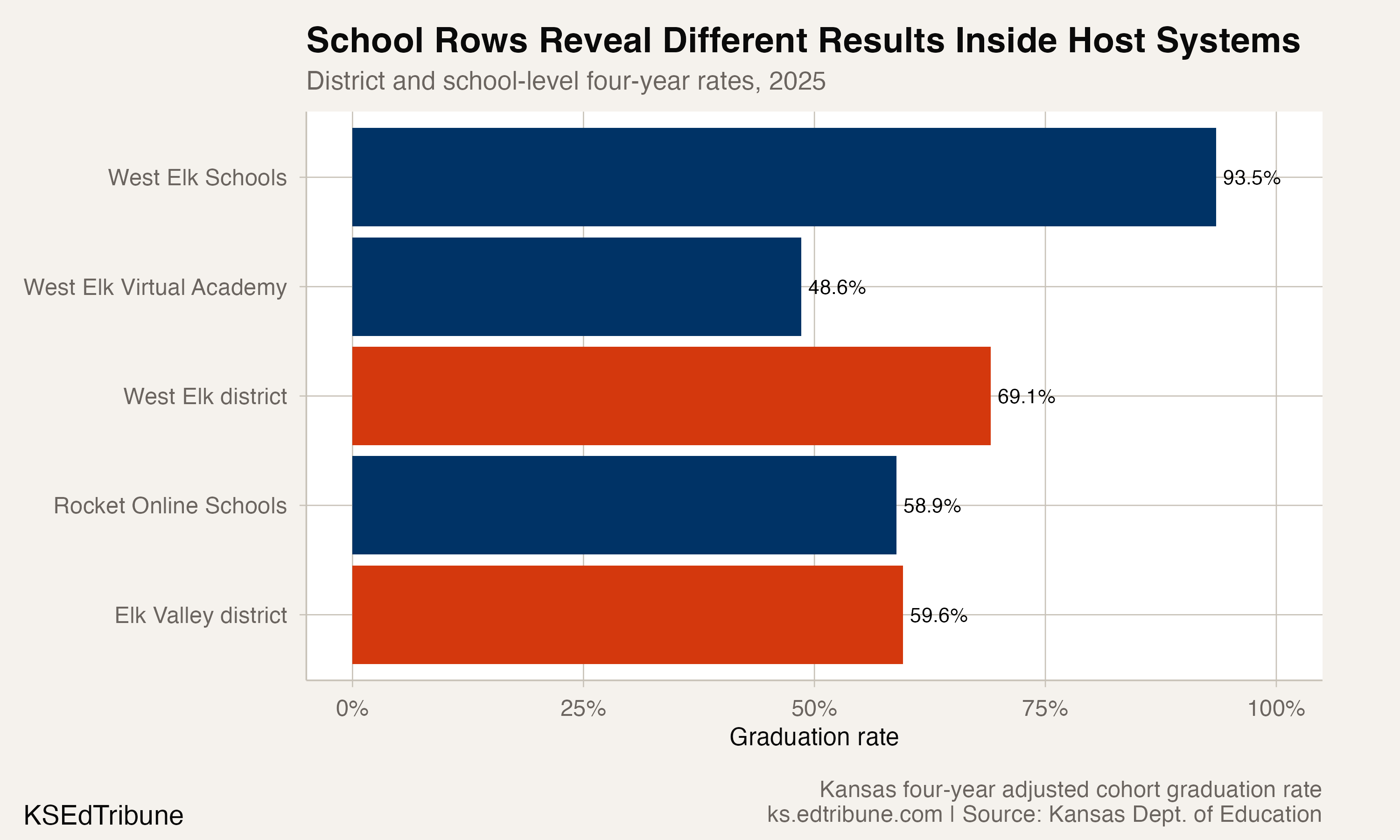
Rocket Online Schools had a 58.9% school-level rate, close to Elk Valley's 59.6% district result. Within West Elk, the package reported 93.5% for West Elk Schools and 48.6% for West Elk Virtual Academy, a 44.9-point difference. The combined district rate was 69.1%.
Those school results show that a single district headline can combine sharply different settings. They do not permit a weighted reconstruction of the district result because the package's cohort and graduate counts are empty.
Enrollment has a nontraditional shape
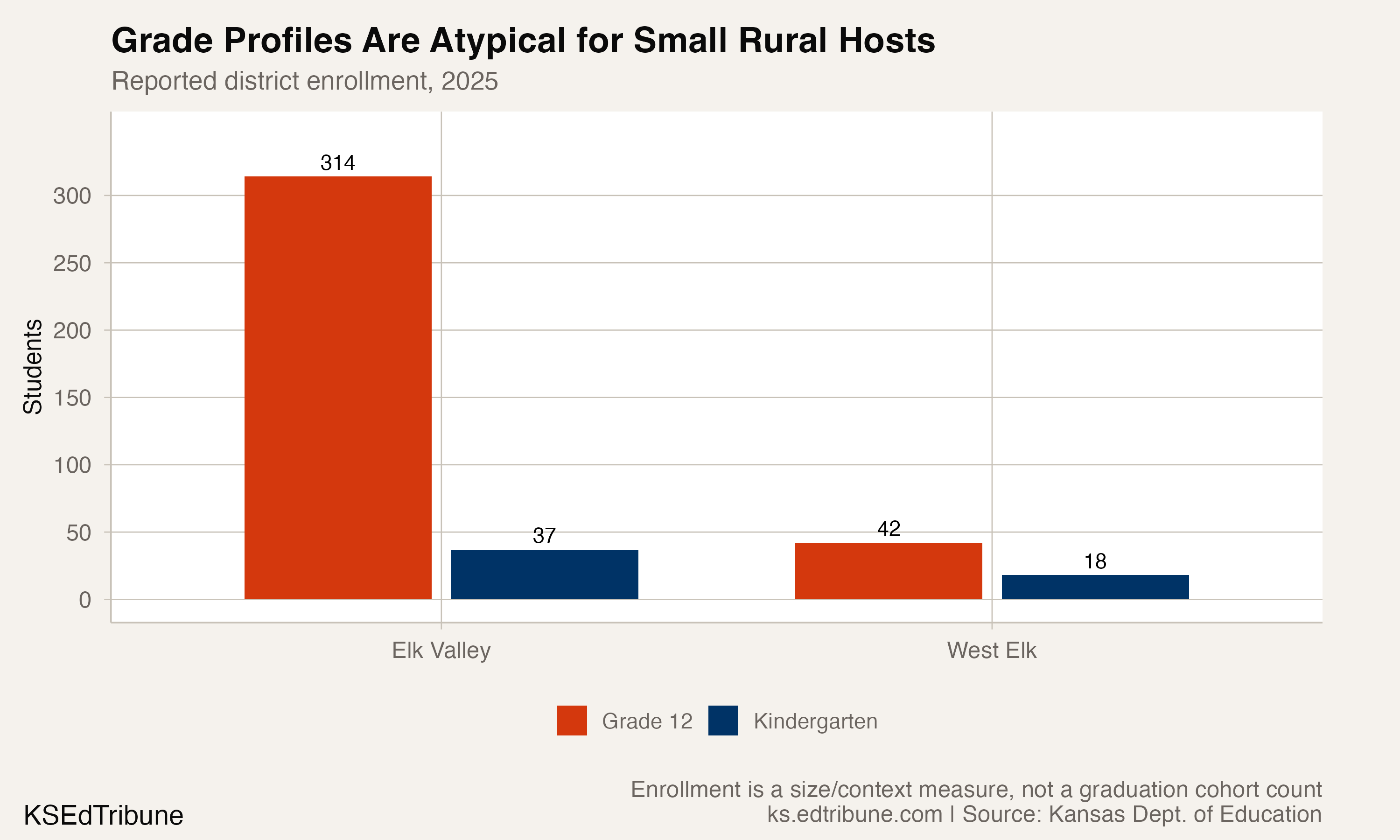
Elk Valley reported 37 kindergartners and 314 twelfth-graders in 2025. West Elk reported 18 kindergartners and 42 twelfth-graders. In both systems, grade 12 was larger than kindergarten, with an especially large imbalance in Elk Valley.
That pattern is consistent with the statewide online-school context, but it is not a graduation cohort count and does not prove why a student graduated or did not. Grade-level enrollment is used here only to set the ranking threshold and show how these host systems differ from a conventional local district profile.
The rate gaps remain material. Kansas's statewide rate was 90.5% in 2025, placing Elk Valley 30.9 points lower and West Elk 21.4 points lower. Delivery mode, student mobility, credit accumulation, cohort composition and program design could all matter, but the aggregate file cannot assign causal weight to any of them.
The useful conclusion is about interpretation as much as ranking: Elk Valley was the size-filtered floor and West Elk was third-lowest, yet both figures describe statewide online-school hosts rather than ordinary place-bound district systems.
Detailed code that reproduces the analysis and figures in this article is available exclusively to EdTribune subscribers.
Discussion
Sign in to join the discussion.
Loading comments...