In this series: Kansas 2025-26 Enrollment.
Kansas reported 31,440 public-school students in the multiracial category in 2025-26. The published statewide total was 471,334, making the category 6.7% of enrollment, about one student in 15.
That share uses the state's own published total. It is not rebuilt by adding up race categories or the district counts that remain after privacy suppression.
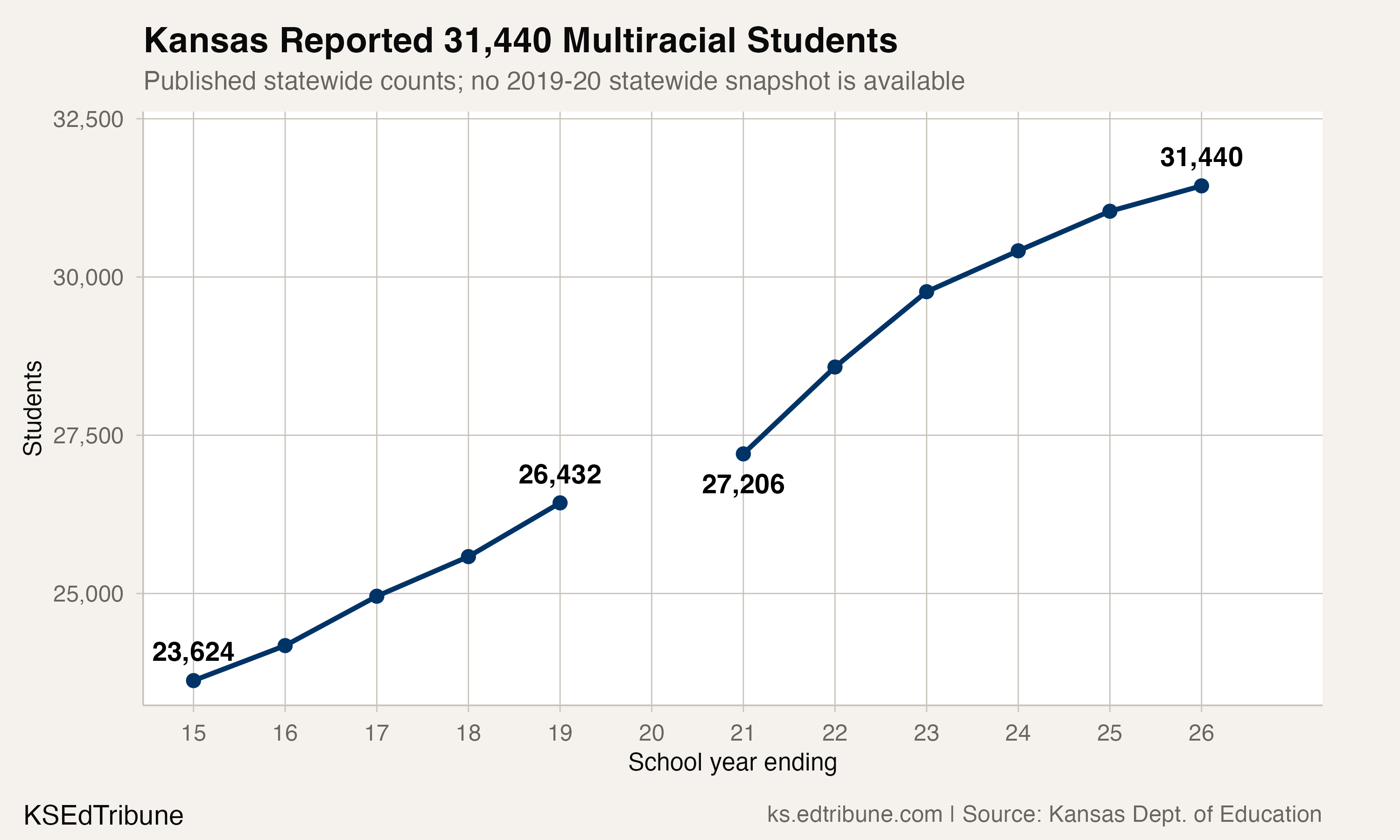
The reported count rose by one-third
The earliest statewide snapshot available in the state's published data used here is 2014-15. It reports 23,624 multiracial students out of 492,906 total students, a 4.8% share.
By 2025-26, the multiracial count had increased by 7,816 students, or 33.1%. Its share rose by 1.9 percentage points even as total enrollment fell by 21,572 students, or 4.4%, across the same endpoints.
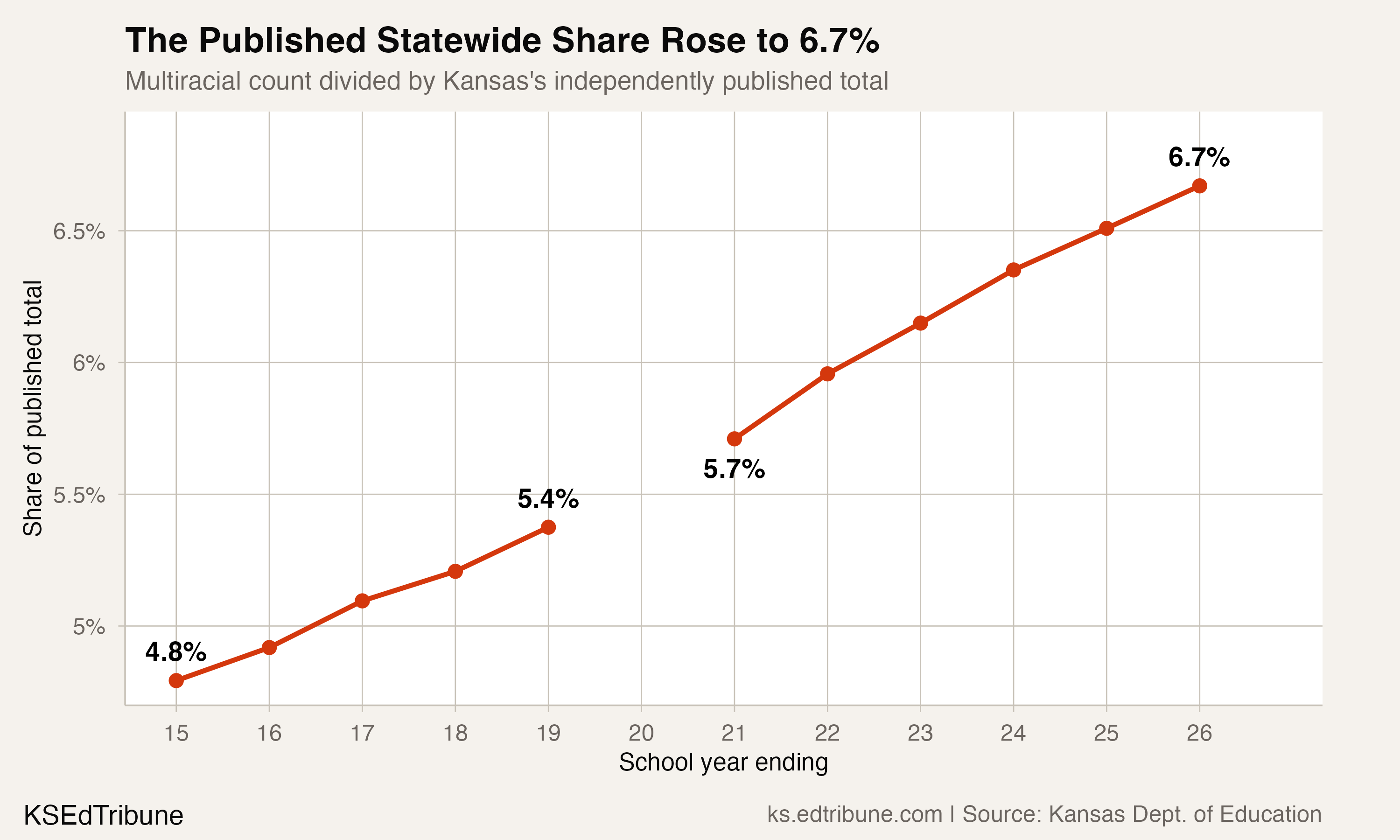
The series has one gap: no 2019-20 statewide snapshot is available in that data. Every successive available snapshot is higher than the one before it, but the 2018-19 to 2020-21 interval spans two school years and is not an annual change.
The latest increase was 401 students, smaller than the prior year's 625-student gain. The largest step between adjacent available snapshots was 1,372 students in 2021-22.
Fastest percentage growth among six reported race categories
Across the six reported state race categories tested from 2014-15 to 2025-26, multiracial enrollment had the fastest percentage growth at 33.1%. Hispanic enrollment rose 16.0%, and Asian enrollment rose 3.8%.
Hispanic enrollment added more students in absolute terms: 14,936, compared with 7,816 for multiracial enrollment. Percentage growth and headcount growth answer different questions.
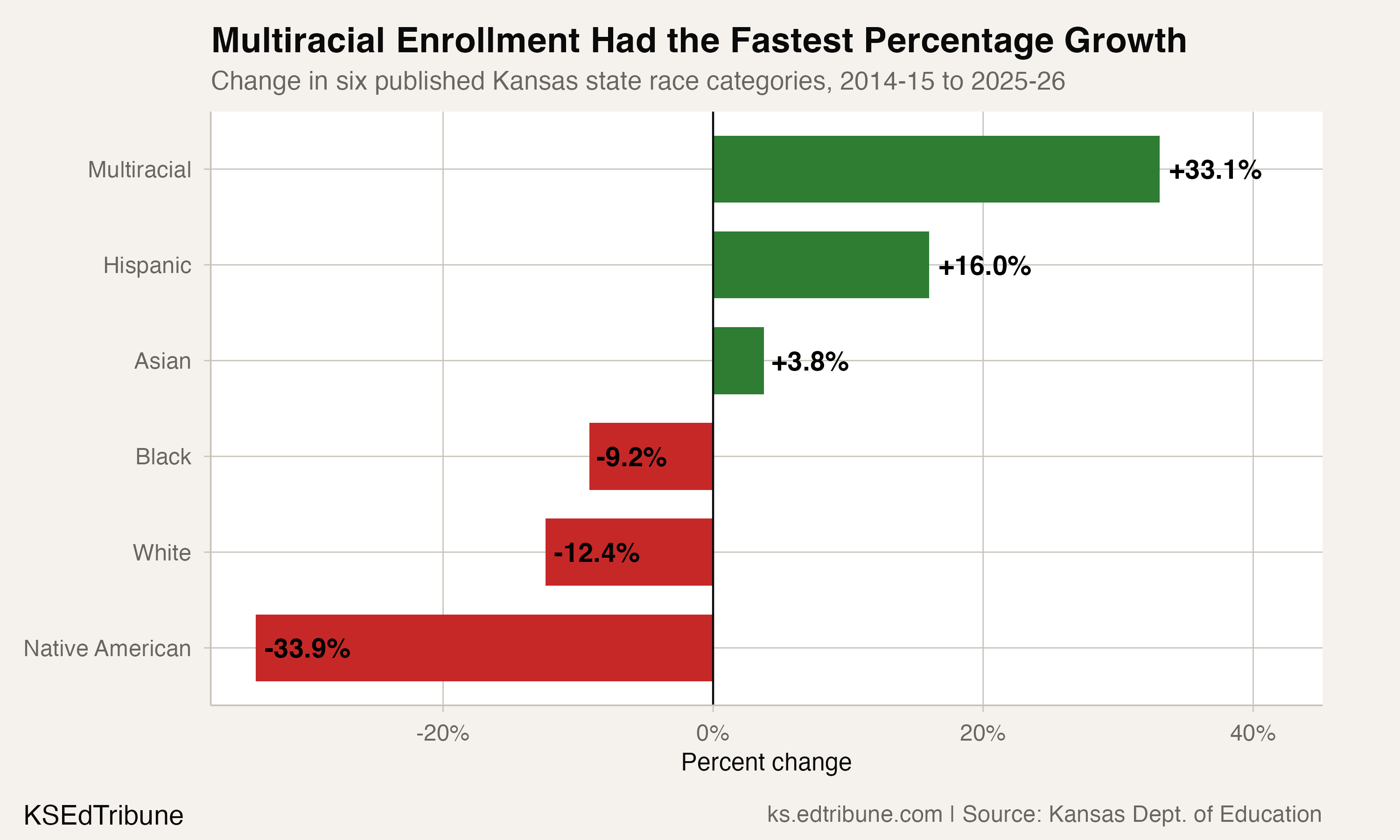
The other three categories declined across the endpoints. Black enrollment fell 9.2%, white enrollment fell 12.4%, and Native American enrollment fell 33.9%.
What a reported category can and cannot show
The state rows measure how students were reported in each race category. They do not contain longitudinal student identifiers or the combinations of identities behind the multiracial category. The counts therefore cannot separate population change, migration, family self-identification, or changes in local reporting practice.
What the counts do show is straightforward: Kansas's published state count for the multiracial category increased from 23,624 to 31,440 across the available 2014-15 to 2025-26 endpoints, while its share of the published statewide total rose from 4.8% to 6.7%.
Detailed code that reproduces the analysis and figures in this article is available exclusively to EdTribune subscribers.
Discussion
Sign in to join the discussion.
Loading comments...