In this series: Kansas 2025-26 Enrollment.
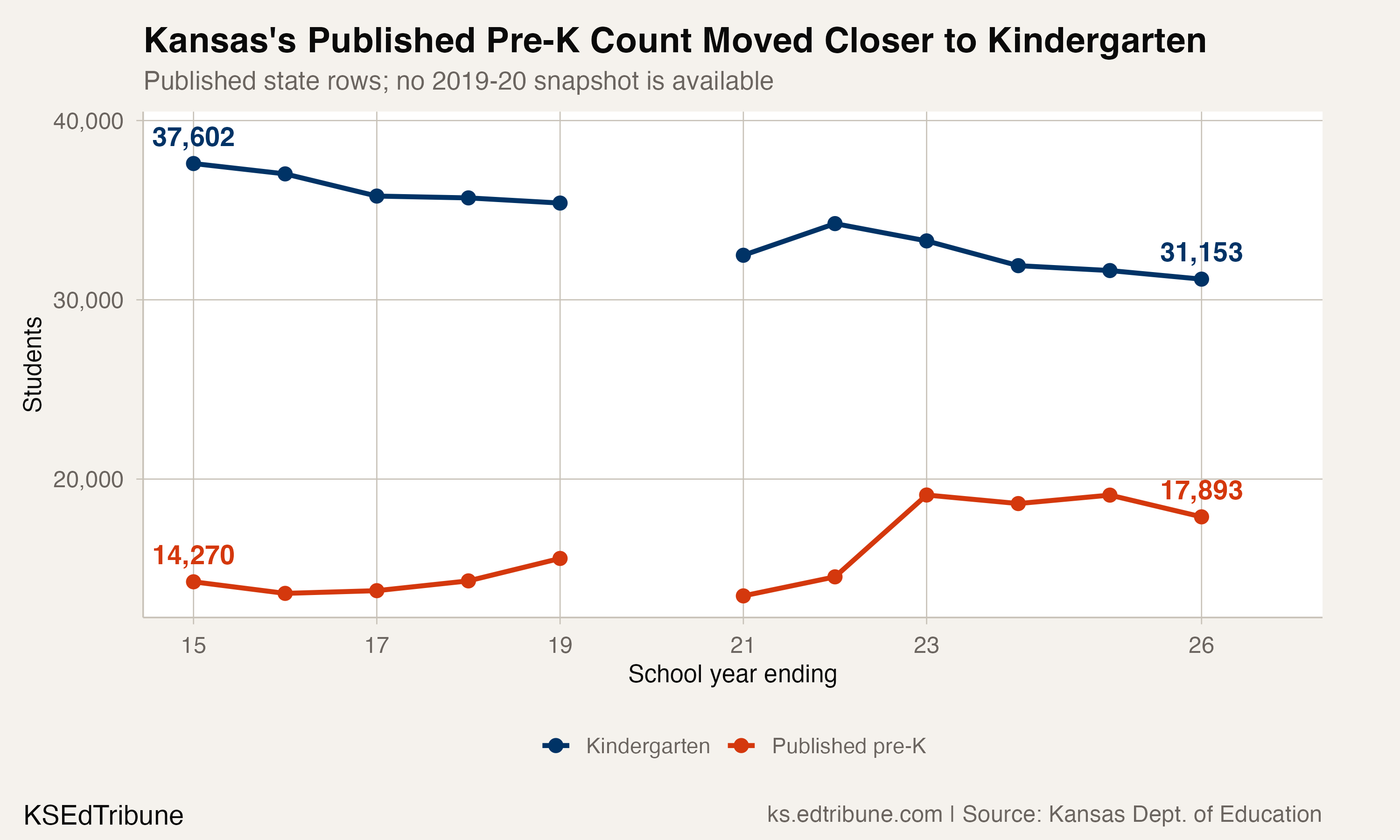
Kansas reported 17,893 students across its published pre-K components and 31,153 kindergartners in 2025-26, last school year and the most recent year in the state's published data. That is 57.4 pre-K students per hundred kindergartners. The pre-K count represents 3.8% of the state's published public-school enrollment total.
Those figures come from Kansas's independently published statewide grade rows, not from a sum of district counts. That distinction matters because the district-level pre-K components contain withheld cells.
A larger published pre-K footprint
In 2014-15, Kansas reported 14,270 students across the published pre-K components and 37,602 kindergartners, a ratio of 38.0 per hundred. By 2025-26, the published pre-K count had gained 3,623 students, or 25.4%, while kindergarten had lost 6,449 students, or 17.2%. The endpoint ratio rose by 19.5 points.
That starting point follows the Kansas State Department of Education's own advice. Amanda Petersen, chief of staff in KSDE's Office of the Commissioner, wrote in June that the state's data systems have changed significantly since 2005, including work to make sure districts include their preschool students in enrollment. "Looking to more recent data - perhaps 2015 and later - would likely give you a more accurate picture of enrollment trends," she wrote.
Kansas's published state files include 11 enrollment snapshots across that span. It does not include a 2019-20 snapshot, so the charts leave that school year blank rather than connecting it to either side.
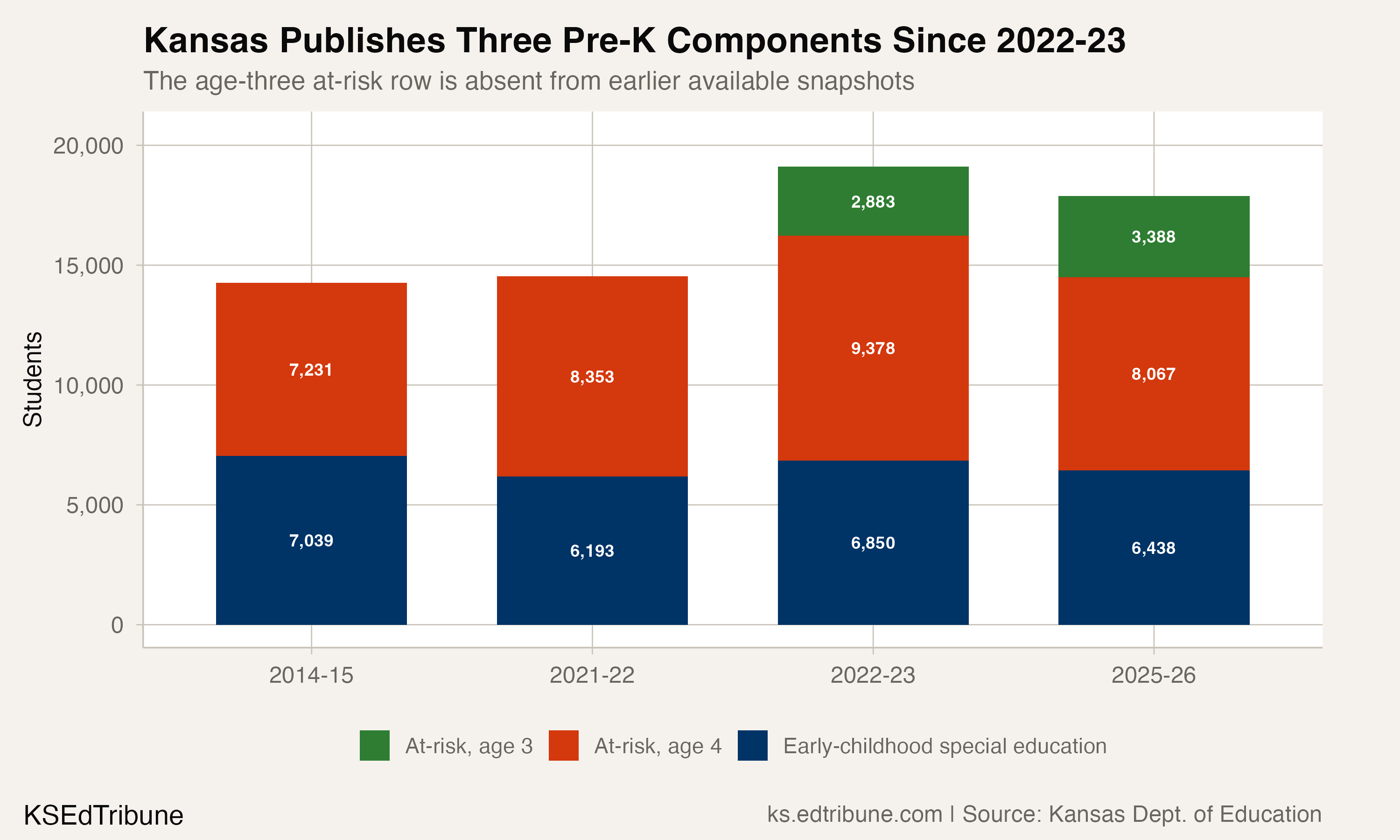
The endpoint comparison also crosses a category change. Kansas published two pre-K components through 2021-22: early-childhood special education and four-year-old at-risk. Beginning in 2022-23, the state data adds a separately labeled three-year-old at-risk component.
That change makes a simple growth narrative unsafe. The published pre-K count rose from 14,546 in 2021-22 to 19,111 in 2022-23, an apparent increase of 4,565 students, or 31.4%. The new three-year-old at-risk row accounted for 2,883 students in the latter snapshot. The data shows that the published universe broadened; it does not establish that every added count represents new participation.
What Kansas includes in the count
The 2025-26 published total combines 6,438 students in early-childhood special education, 3,388 in the three-year-old at-risk category and 8,067 in the four-year-old at-risk category.
A pre-K count is not the same as a count of children in a preschool classroom. Petersen explained that Kansas preschool enrollment includes children with disabilities receiving IEP services, "who may or may not also be attending a public school classroom." It can also include children who are not funded through the school finance formula, and "some of these may be students receiving other services from the district (like Parents as Teachers home visiting) but not attending a preschool classroom."
The Kansas State Department of Education's preschool-programming page likewise describes the Preschool-Aged At-Risk program, the Kansas Preschool Pilot and early-childhood special education as related but distinct supports. The state total is best read as a collection of program components, not a single uniform program.
The data cannot separate changes in eligibility, reporting and participation. Those remain competing explanations for the longer endpoint shift.
The latest comparable stretch moved sideways
From 2022-23 through 2025-26, when the same three components appear in every available snapshot, published pre-K enrollment fell by 1,218 students, or 6.4%. Kindergarten fell by 2,133 students, also 6.4%. The ratio began and ended at 57.4 pre-K students per hundred kindergartners, after reaching 60.4 in 2024-25.
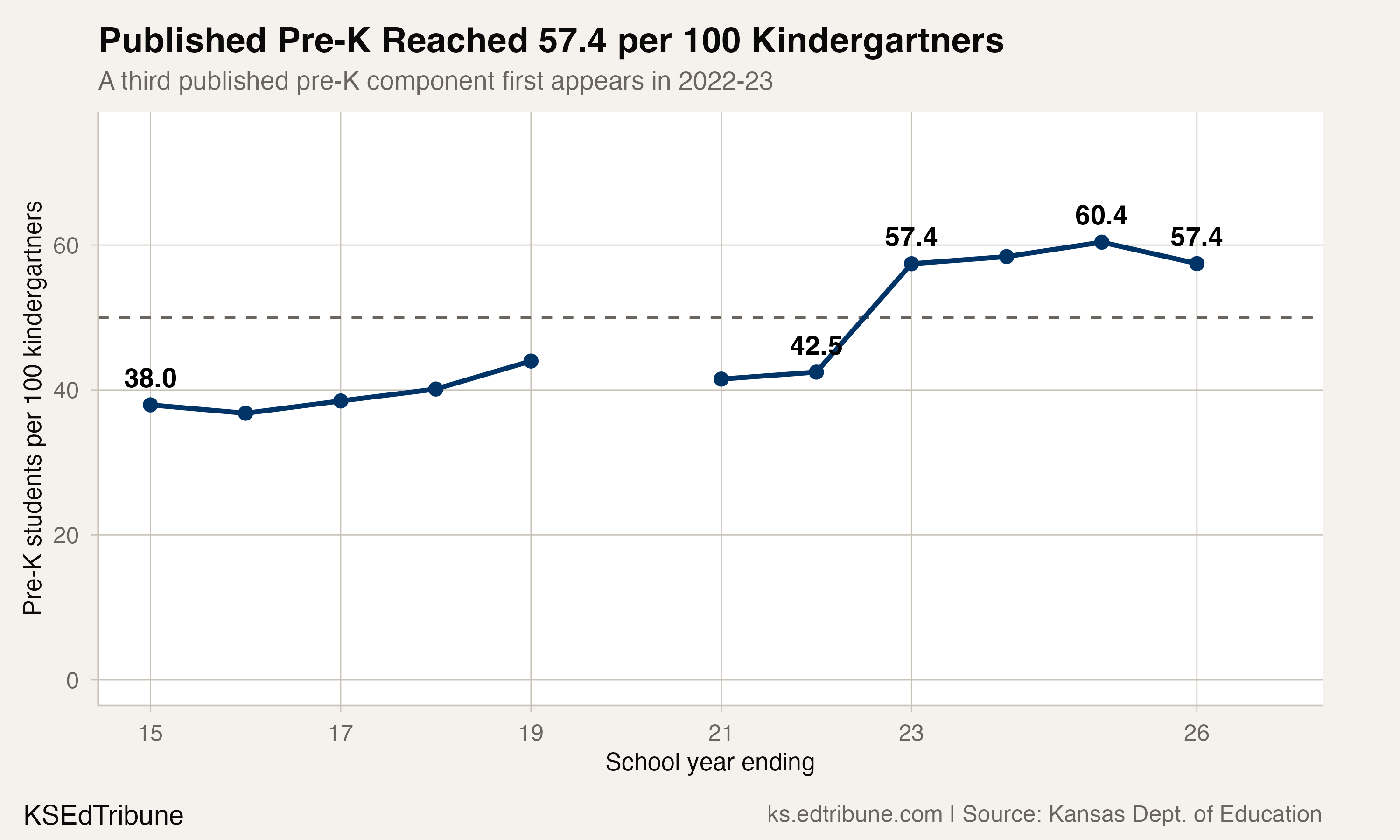
That recent span is better described as a shared contraction than continued convergence. Both counts moved down at almost the same rate, leaving the ratio unchanged at the endpoints.
Asked whether the flattening reflects capacity, funding, reporting or a smaller pool of eligible children, Petersen cautioned against a single answer. "I'm not sure that we have enough data to confidently respond to this question, and I would expect that the answer would vary depending on the local community," she wrote.
Funding is one thing to watch in 2026-27, the current school year, which the published data does not yet cover. Petersen wrote that "beginning in 2026-2027 the Kansas Preschool Pilot - which is a discretionary grant program to supplement other sources of preschool funding - will no longer receive Children's Initiatives Fund funding." She said the fund, which comes from the state's share of the tobacco settlement, is under pressure as more people vape instead of smoking.
Statewide clarity, local limits
The statewide total is complete because Kansas publishes it independently. The local picture is less certain. Wichita↗ET and Kansas City↗ET, for example, each have at least one withheld pre-K component in the 2025-26 district records. Adding the visible components would treat withheld students as zero.
That is why this version does not rank districts, count which districts operate pre-K or estimate local pre-K-to-kindergarten ratios. The defensible finding is statewide: Kansas's published pre-K count is much closer to kindergarten than it was in 2014-15, but the newest comparable snapshots do not show the ratio continuing to rise.
For district planning, Petersen pointed to local partners such as private preschools, child care providers, home visiting programs and early intervention services. Working with them, she wrote, helps districts "forecast community trends as they prepare to welcome incoming kindergarten students."
Detailed code that reproduces the analysis and figures in this article is available exclusively to EdTribune subscribers.
Discussion
Sign in to join the discussion.
Loading comments...